
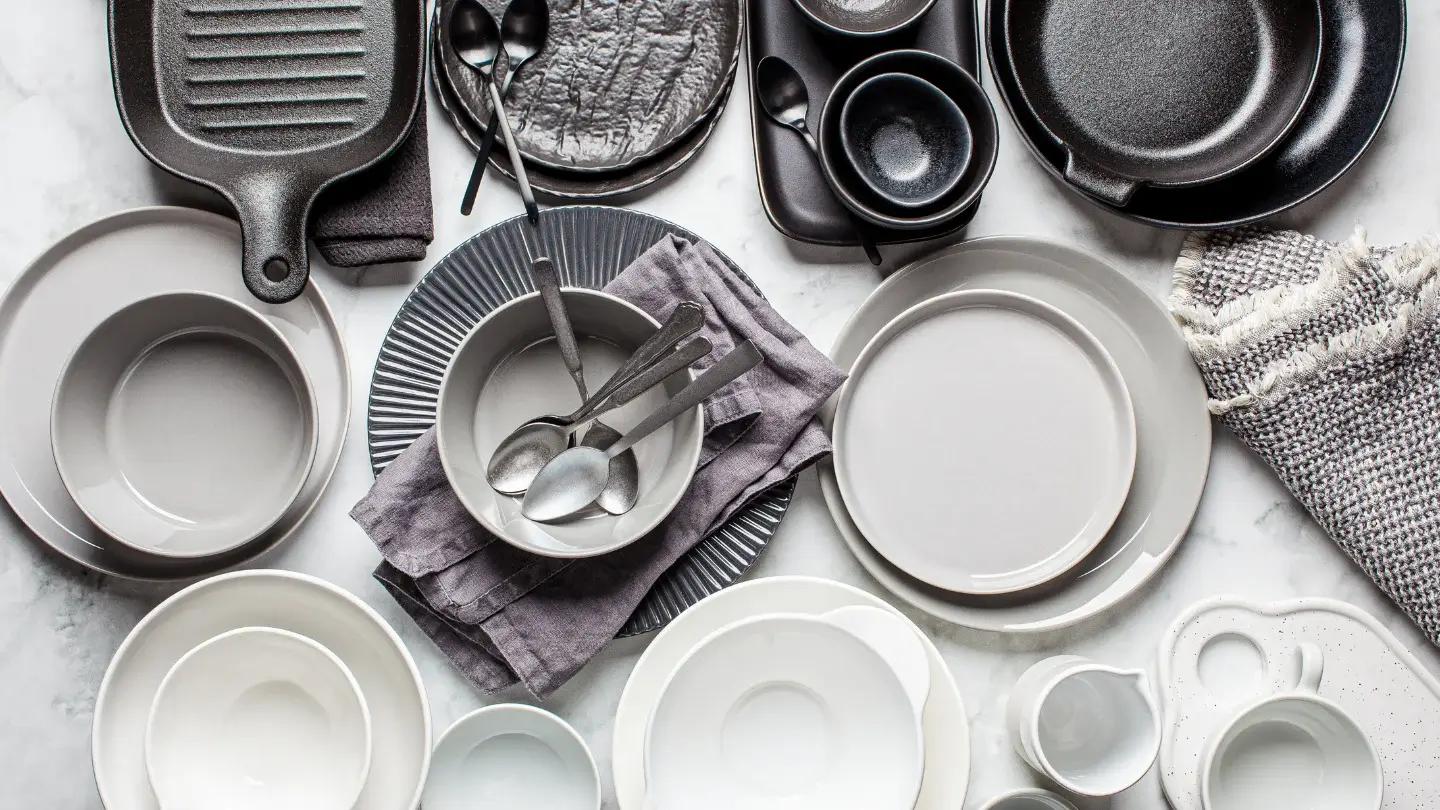
Walk down the cookware aisle in any Kannur kitchenware store today, and the non-stick shelf looks different from a few years ago. Pans labelled “ceramic,” often stamped with a PFOA-free or PFAS-free sticker, sit right next to the familiar black Teflon-coated sets. If you’re asking is ceramic cookware safe, or simply trying to work out which cookware is safe for cooking day to day, the honest starting point is a question most shoppers skip entirely: which kind of “ceramic” are you actually looking at?
Ceramic Cookware Is Really Two Different Products
“Ceramic cookware” gets used as a catch-all for two genuinely different things. The first is 100% ceramic cookware — solid, fired clay, the same basic material behind the earthen manchatti many Kerala kitchens still use for fish curry and rice. The second, and by far the more common one on retail shelves, is ceramic-coated cookware: an ordinary aluminium or stainless steel pan with a non-stick ceramic layer sprayed onto the surface. These answer the “are ceramic cookware safe” question quite differently, so it’s worth treating them separately rather than lumping them together.
It’s also worth being clear that this is different from ceramic crockery — the plates and bowls on your dining table rather than the pots and pans on your stove. If you’re deciding between tableware materials rather than cookware, our melamine vs ceramic crockery guide covers that comparison; the safety and durability questions there play out differently because tableware and cookware face completely different heat and wear conditions.
What Sol-Gel “Ceramic” Coating Actually Is
Most cookware marketed as ceramic today isn’t ceramic in the traditional sense at all. According to the American Ceramic Society, these coatings are more accurately described as “quasi-ceramic”: a mixture of silica, metal oxides, and binders sprayed onto a metal pan and fired at 400°F to 800°F, well below the 2,000°F-plus temperatures used to fire genuine ceramic. The resulting surface looks and feels like ceramic, which is exactly why it’s marketed that way, even though the chemistry is closer to a glass-like coating than fired clay.
This is the process behind Prestige’s Ceraglide range, which TTK Prestige markets as a PFOA- and PFAS-free, gas- and induction-compatible non-stick option. Prestige is one of the non-stick cookware brands stocked in Cater Circle’s home kitchen range, so it’s worth asking in-store which specific lines are ceramic-coated versus standard non-stick, since both currently sit under the same product category.
Is Ceramic Actually Safer Than Teflon?
This is where marketing tends to get ahead of the science. The genuine advantage of ceramic sol-gel coatings is that they don’t contain PTFE or PFAS, the so-called “forever chemicals” family that includes Teflon. Healthline’s review of nonstick cookware safety notes that PTFE coatings only begin breaking down above roughly 260°C (500°F), releasing fumes that can cause a temporary flu-like illness known as polymer fume fever — a real but narrow risk tied to overheating an empty pan or broiling at very high heat. NRDC’s reporting on nonstick cookware adds that scratched or damaged PTFE coatings can shed microplastic particles into food, which is the more everyday concern for a pan that’s a few years old and visibly worn.
Ceramic coatings sidestep the PFAS question entirely, but they trade one problem for another: durability. Lab comparisons cited by Sustainable Jungle — including 2024 testing published in the Journal of Food Engineering and 2025 testing in Results in Engineering — found that PTFE coatings held their non-stick performance far longer than ceramic sol-gel coatings after repeated cooking cycles. In practical terms, a ceramic-coated pan is likely to lose its non-stick surface and need replacing sooner than a comparable Teflon pan, even though it carries less chemical baggage while it’s intact.
What About 100% Ceramic or Clay Cookware?
Solid ceramic and traditional clay cookware raise a different question, and it comes down to the glaze rather than the base material. Unglazed clay is generally inert, but independent testing summarised by ireadlabelsforyou found that unglazed earthenware can still leach arsenic at up to ten times the rate of glazed pieces, and that some traditional unglazed pots released lead, cadmium, and iron above WHO safety limits, depending on the clay source. Glazed clay pots aren’t automatically safer either — a poorly made or cheaply decorated glaze is itself a potential source of heavy metals.
For anyone buying a traditional clay pot for slow-cooked curries or rice, the practical takeaway is to buy from a known, reputable source rather than an unlabelled stall, and to be cautious with very brightly glazed or hand-painted pieces, which are the ones most likely to use unregulated pigments.
Does Ceramic Cookware Work on Your Stove?
This is the practical question that trips up a lot of buyers after they’ve already decided ceramic sounds like the safer option. Most ceramic-coated cookware has an aluminium core, which isn’t magnetic and therefore won’t work on an induction cooktop unless the manufacturer has bonded on a magnetic base — the same rule that applies to any aluminium or copper pan. If you’re deciding between cooking surfaces, our induction cooktop vs gas stove comparison covers the magnet test and which cookware materials are actually compatible in more detail.
Regulation and What to Look For When Buying
India’s cookware regulation has moved fairly fast over the past two years. The Cookware and Utensils Quality Control Order 2024 initially made BIS certification mandatory for both stainless steel and aluminium utensils, but a 2026 update tracked by Intertek has since narrowed mandatory certification to aluminium utensils and cans only, removing stainless steel from the compulsory list. Since ceramic-coated cookware is almost always built on an aluminium base, this is the standard that applies to it in practice. Checking for the BIS Standard Mark, alongside a manufacturer’s own PFOA/PFAS-free documentation, is a reasonable baseline before buying any coated non-stick pan.
Beyond certification, the same habits that protect any non-stick surface apply to ceramic: avoid metal utensils and abrasive scourers, don’t preheat an empty pan, and replace it once the coating visibly thins or discolours rather than waiting for it to flake into food. If long-term durability matters more to you than the coating question, it’s worth weighing ceramic against the stainless steel and hard-anodized aluminium options in our pressure cooker material guide, since the same reactivity and longevity trade-offs apply across cookware generally, not just pressure cookers.
Where Cater Circle Fits In
Cater Circle, operating from Manjapalam in Kannur since its roots under Popular Stores in 1943, stocks Prestige’s non-stick cookware lineup alongside stainless steel, hard-anodized, and traditional options, so you can compare a ceramic-coated pan against its alternatives in person rather than guessing from a product photo. As customer Dr. KT Ajmal noted in a review, the store has been a dependable one-stop option for kitchen appliances over several years of shopping. For anything specific to a ceramic-coated line, it’s worth calling ahead to confirm current stock: +91 702 557 6666.
FAQ: Ceramic Cookware Safety
Is ceramic cookware safe to cook with?
Yes, for both major types, with caveats. Ceramic-coated (sol-gel) cookware is free of PTFE and PFAS but wears out faster than Teflon-based non-stick. Solid ceramic or clay cookware is safe when the clay source and glaze are properly tested; a poor-quality glaze is the actual risk, not the ceramic itself.
Is ceramic coated cookware safe for daily use?
Yes, under normal cooking conditions. The coating doesn’t release PFAS-related fumes the way overheated PTFE can. The main practical issue is durability — expect the non-stick surface to degrade faster than a comparable Teflon pan under heavy daily use.
Is 100% ceramic cookware safer than ceramic-coated cookware?
It depends on the glaze. Pure ceramic avoids the sol-gel coating question entirely, but a poorly glazed piece can leach lead or cadmium, while a well-made ceramic-coated pan from a reputable brand is generally safe for normal use.
Does ceramic cookware work on an induction cooktop?
Only if it has a magnetic base. Most ceramic-coated pans use an aluminium core, which isn’t induction-compatible unless the manufacturer has bonded on a magnetic layer. A simple fridge-magnet test on the base tells you in seconds.
Is ceramic cookware better than non-stick Teflon cookware?
Neither is universally better. Ceramic avoids PFAS chemistry but degrades faster; PTFE lasts longer but carries the narrow, overheating-related fume risk that ceramic doesn’t. The right choice depends on whether you prioritise chemical composition or long-term durability.
Where can I compare ceramic and non-stick cookware in Kannur?
Cater Circle in Manjapalam, Kannur, stocks Prestige’s non-stick and ceramic-coated cookware alongside stainless steel and hard-anodized options. Call +91 702 557 6666 or visit catercircle.in to check current stock.