
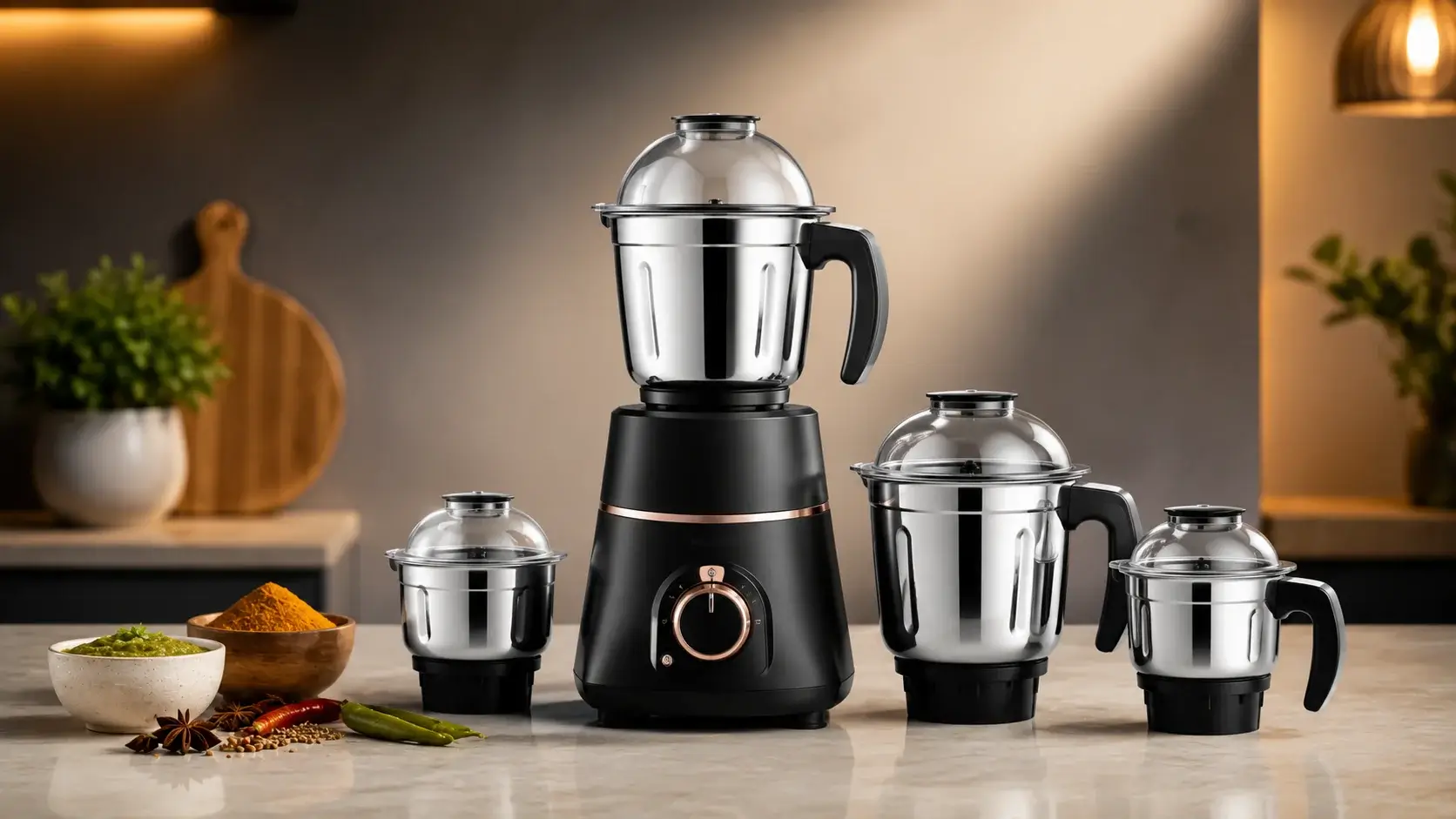
You can hear it from the next room before you even see it — that distinctive whir-and-grind of the mixer grinder doing its morning shift, turning soaked urad dal into batter or coconut into chutney paste in under a minute. If the pressure cooker is the appliance that defines when an Indian kitchen eats, the mixer grinder is the one that decides how it tastes. And yet, walk into any appliance aisle and the choice gets confusing fast: Prestige or Sujata, 750 watts or 1000, stainless steel jars or polycarbonate, three jars or five.
This guide cuts through that confusion. We’ll look at what the BIS actually requires of a “domestic” mixer grinder, why 750 watts keeps showing up as the benchmark number, how the major brands in the Indian market actually differ, and how to match a machine to your kitchen — whether that’s a home in Kannur or a small catering operation scaling up.
Why Mixer Grinders Are Non-Negotiable in Indian Kitchens
Indian cooking is built on wet and dry grinding in a way that few other cuisines are. Dosa and idli batter, coconut-based gravies, ground masalas, chutneys — almost none of it survives without a motor doing the work that a stone grinder used to do by hand. That dependency shows up clearly in the numbers: India’s mixer juicer and grinder market reached USD 515.77 million in 2024 and is projected to grow to USD 824.14 million by 2033, according to IMARC Group’s industry analysis — a steady climb driven less by novelty and more by the simple fact that the appliance is now considered a kitchen essential rather than a luxury.
That’s a different growth story than premium gadgets follow. Mixer grinders aren’t selling because of a new feature wave; they’re selling because urban households are setting up new kitchens, older units are reaching end-of-life after years of daily turmeric and chilli grinding, and — as is true across most Indian kitchen appliance categories — South India’s batter-and-chutney cooking style keeps demand for grinding power particularly high in this region.
The 750-Watt Standard: What BIS Actually Requires
If you’ve searched for a mixer grinder for home use, you’ve almost certainly noticed that 750 watts comes up constantly as the “right” number. That’s not marketing convention — it’s regulatory.
Every mixer grinder sold legally in India for domestic use must carry an ISI mark certified under IS 4250, the Bureau of Indian Standards specification covering domestic electric food mixers, liquidizers, and grinders. This certification became mandatory under the BIS Kitchen Appliances (Quality Control) Order, 2018, which took effect in 2019 and made it illegal to manufacture, import, or sell an uncertified mixer grinder in India. The certification covers electrical safety, insulation, leakage current, and mechanical strength — the kind of testing that actually prevents shocks and motor fires, not just a sticker.
Here’s the detail most buying guides skip under this same standard, the domestic mixer grinder category is explicitly capped, with rated input for these products required to stay at or under 750 watts. That’s why nearly every “best mixer grinder for home” recommendation lands on 750W — it’s effectively the ceiling for what counts as a domestic appliance under Indian regulation. Anything marketed above that wattage for home use is technically operating in a different classification, which is part of why 900W and 1000W models tend to be positioned as “heavy-duty” or semi-commercial rather than standard domestic units.
Market segmentation data backs this up directly: industry trackers split the Indian mixer grinder market into three wattage bands — up to 550 watts, 551–750 watts, and above 750 watts — with the 551–750-watt segment consistently representing the bulk of residential demand.
Wattage Quick-Reference
| Wattage Band | Typical Use Case | Household Fit |
| Up to 550W | Light grinding, chutneys, small batches | 1–2 person household |
| 551–750W | Daily masalas, dosa/idli batter, everyday cooking | 3–5 person household |
| 900–1000W+ | Tough ingredients (turmeric, dried coconut), frequent batch cooking | Large families, near-commercial use |
Best Mixer Grinder Brands in India: The Real Landscape
The Indian mixer grinder market includes both legacy domestic manufacturers and multinational players, with researchandmarkets.com identifying Philips, Panasonic, Bajaj Electricals, Preethi Kitchen Appliances, Butterfly Gandhimathi Appliances, Bosch, Havells, and Sujata as the most prominent companies competing in this category. Cater Circle’s in-store range focuses on two of the most established names in that list — Prestige and Sujata — so here’s an honest look at where each one stands, plus the broader market context worth knowing before you buy.
Prestige: The Multi-Functional Generalist
Prestige’s mixer grinder range follows the same logic as its pressure cooker lineup — broad accessibility, multiple price points, and a focus on versatility over specialization. A Prestige mixer grinder typically ships with multiple jars covering wet grinding, dry grinding, and chutney-making, often with juicing or dough-kneading attachments bundled in on mid-to-premium models. For a household that wants one appliance to handle most kitchen prep tasks without buying separate single-purpose machines, Prestige’s generalist approach is the practical pick.
Sujata: The Heavy-Duty Specialist
Sujata has built its entire identity around motor durability rather than feature count. The company’s own account of its founding traces back to 1979, when it set out specifically to prove that Indian-engineered appliances could match international quality benchmarks — and four-plus decades later, that durability-first reputation is still the brand’s core pitch. Sujata mixer grinders are known for higher-RPM motors and double ball-bearing construction designed to handle continuous grinding sessions, which is exactly the profile that suits households doing daily batter and masala prep at volume, or smaller juice bars and tiffin services that need a step up from a purely domestic machine without moving to fully commercial equipment.
The Wider Market: Preethi, Bajaj, and Others
Beyond what Cater Circle stocks, it’s worth knowing how the rest of the market is structured, since you’ll encounter these names in nearly every comparison list online. Preethi — long considered the dominant South Indian mixer grinder brand — became a wholly owned subsidiary of Philips India through a series of investments following an initial 2011 acquisition reported at Rs 350 crore, with Philips later consolidating full ownership. That deal effectively merged a multinational’s manufacturing discipline with a brand built specifically around Indian cooking habits. Bajaj, Butterfly, Panasonic, Bosch, and Havells round out the rest of the field, each competing primarily on price point, motor technology, or after-sales network density rather than any single standout feature.
Home Use vs Commercial Use: Why a Domestic Mixer Won’t Survive a Catering Kitchen
This is the distinction that trips up a lot of buyers, especially anyone scaling from home cooking into a small catering or tiffin business. A domestic mixer grinder — by regulation, the one capped at 750W — is built for intermittent use: a few grinding sessions a day, with rest periods in between. Run that same machine for hours of continuous batter production and the motor will overheat, regardless of brand.
This is exactly why commercial kitchens use entirely different equipment. As outlined in Cater Circle’s full catering equipment checklist, South Indian catering menus that depend on freshly ground dosa and idli batter at scale require dedicated commercial wet grinders and food processors, not domestic mixer grinders — a 200-cover breakfast service will burn out a household-grade motor within days. If you’re setting up or supplying a restaurant, hotel kitchen, or catering operation, the right starting point is Cater Circle’s restaurant and catering equipment range rather than the home kitchen aisle, and for hospitality businesses needing institutional volumes, the commercial and hospitality supplies section covers the bulk procurement side of that requirement too.
What to Check Before You Buy
Whichever brand you land on, a few specifics matter more than marketing copy:
- ISI mark on the box and unit — confirms BIS certification under IS 4250; don’t buy a mixer grinder without it, regardless of price.
- Number and material of jars — stainless steel jars resist staining and odour retention better than polycarbonate over years of masala grinding; most home-use models ship with 3 to 5 jars covering wet grinding, dry grinding, and chutney duties.
- Overload protection — an automatic motor cutoff prevents burnout when a jar is overloaded or a thick batter stalls the blades.
- Stated wattage vs actual rated input — check that the wattage on the box matches what’s declared on the BIS certification scope, since this is one of the parameters BIS testing explicitly verifies.
- Local service availability — a mixer grinder is a long-term appliance; brands with service centres or dealer support in your city save real money on gasket, jar, and motor repairs down the line.
Buying in Kannur: What Cater Circle Stocks
Cater Circle’s home kitchen section carries both Prestige and Sujata mixer grinders in-store, which means you can compare jar quality, motor noise, and build weight side by side before deciding — something no product listing page can replicate. That kind of hands-on comparison matters more for an appliance you’ll use daily for years than it does for most other kitchen purchases.
This is also where Cater Circle’s legacy dating back to 1943 under Popular Stores becomes relevant in a very practical way: decades of selling kitchen appliances in Kannur means the team has a working sense of which models hold up to local water hardness, voltage fluctuation, and the kind of daily grinding load that a typical Kerala household puts on a mixer grinder — context that’s hard to get from an online listing alone.
Frequently Asked Questions
1. Which is the best mixer grinder brand in India?
There’s no single universal answer — it depends on whether you prioritise versatility or raw durability. Prestige is the stronger pick for households that want one multi-functional appliance covering grinding, juicing, and light food prep. Sujata is the stronger pick for households or small businesses that grind heavy volumes daily and want a motor built to outlast everything else in the kitchen.
2. Is 750 watts enough for a mixer grinder?
Yes, for the vast majority of Indian households. 750 watts is also the maximum rated input permitted under BIS’s IS 4250 standard for domestic mixer grinders, which is why it’s the most common specification on the market. It comfortably handles daily masalas, chutneys, and dosa or idli batter. Families that grind tough, dry ingredients like turmeric root or large batches of coconut on a daily basis may prefer a 900W or 1000W model, which typically falls into the semi-commercial or heavy-duty category rather than standard domestic classification.
3. What’s the difference between a mixer grinder and a wet grinder or food processor?
A mixer grinder handles a wide range of everyday tasks — dry spice grinding, wet chutneys, light batters, and juicing with the right jar — but it’s built for intermittent, short-duration use. A dedicated wet grinder is built specifically for continuous, high-volume batter production (the kind needed for catering or commercial dosa service) and uses stone or granite grinding mechanisms rather than blade-based jars. A food processor prioritises chopping, slicing, and kneading attachments over fine grinding. Most home kitchens only need a mixer grinder; commercial kitchens typically need both a mixer grinder and a separate wet grinder.
4. Do mixer grinders need a BIS or ISI mark?
Yes. Since the BIS Kitchen Appliances (Quality Control) Order, 2018 came into effect, it has been mandatory for every domestic electric mixer grinder sold in India to carry ISI certification under IS 4250. Buying an uncertified or unbranded mixer grinder isn’t just a quality risk — it’s a product that isn’t legally permitted to be sold in the Indian market in the first place.
5. What size mixer grinder do I need for home use?
For a household of one or two people, a 500–550W model with two to three jars is generally sufficient. A family of three to five is best served by a standard 750W model with three to five jars. Larger families, or households that grind tough ingredients or large batches daily, should look at 900W to 1000W heavy-duty models.
6. Where can I buy a genuine mixer grinder in Kannur?
Cater Circle stocks genuine Prestige and Sujata mixer grinders at its Manjapalam location in Kannur, alongside the rest of its home kitchen range. You can contact the Cater Circle team directly at +91 702 557 6666 to check current stock and pricing before visiting.
Browse Cater Circle’s home kitchen range in Kannur: