
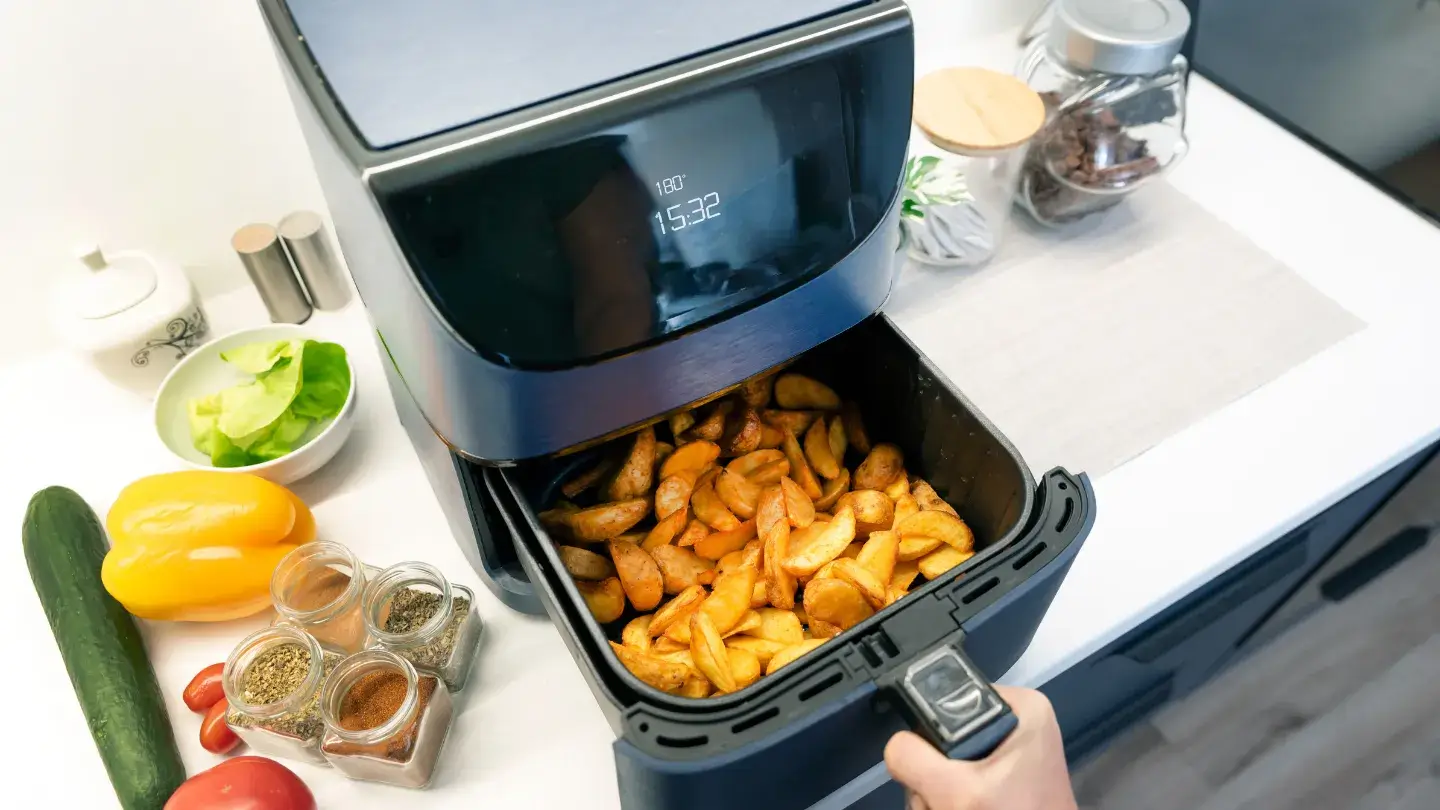
Air fryers have moved from novelty to daily-use appliance in a lot of Indian kitchens over the past couple of years, and a good part of that has been driven from the top: on World Health Day, Prime Minister Narendra Modi urged citizens to cut their cooking oil intake by at least 10 percent as a simple step against lifestyle diseases, a message he has repeated more than once since. An appliance that crisps food with a fraction of the oil fits that message neatly, which is one reason so many households are pulling one out of the box for the first time this year.
What trips people up isn’t the appliance, it’s the cookware they put inside it. Air fryer safe cookware isn’t a single category you can buy off a shelf labelled as such; it’s really a question of which materials already in your kitchen can handle short bursts of very high, fast-moving hot air without warping, cracking, or leaching anything into your food. This guide goes through each material on its own terms.
How an Air Fryer Actually Cooks (and Why the Material Matters)
An air fryer works by circulating very hot air at high speed around the food in a small, enclosed basket. That’s a meaningfully different environment from a stovetop flame or even a full-size oven: the heat is more concentrated, it hits the cookware from every direction at once, and the basket itself is compact enough that a container barely fits with room for air to move. That combination is exactly why some materials that are perfectly fine in an oven can behave differently in an air fryer, and why “oven-safe” is a useful starting point but not always the final word.
Metal: Stainless Steel and Aluminium Are the Safest Default
Stainless steel and aluminium are, materially, the least complicated answer to what pans are safe to use in an air fryer. Neither reacts with food, both tolerate high heat without degrading, and both are already common in Indian kitchens in the form of steel bowls, small kadais, and aluminium cake tins repurposed for air frying.
In India specifically, this is also now a regulated category rather than a loose one. The Government of India’s Department for Promotion of Industry and Internal Trade made BIS certification mandatory for stainless steel and aluminium utensils under a Quality Control Order dated March 14, 2024, with stainless steel covered under IS 14756:2022 and aluminium under IS 1660:2024. The stainless steel standard specifically includes a thermal shock test as part of certification, which is a fairly direct proxy for how a utensil will hold up to an air fryer’s heat cycles. Practically, that means the ISI mark on a steel bowl or aluminium tin is a genuine signal, not just a formality.
The one caution worth knowing, particularly for aluminium: the FDA has separately flagged certain imported aluminium alloy cookware sold under names like Hindalium or Indalium for the potential to leach lead, based on testing of specific uncertified products. This isn’t a blanket problem with aluminium as a material; it’s a reason to favour BIS-marked aluminium from an established manufacturer over very cheap, unbranded pieces, which is the same logic the ISI mark exists to support. Cater Circle’s home kitchen range stocks steel utensils and aluminium cooking vessels from established brands for exactly this reason.
Can You Use Glass Cookware in an Air Fryer?
Yes, but the type of glass matters more than most people assume. Glass cookware splits into two families with very different heat behaviour: borosilicate glass, which contains boron trioxide and has a low rate of thermal expansion, and ordinary soda-lime glass, which expands and contracts more with temperature and is more prone to cracking under a sudden shift in heat, a phenomenon known as thermal shock. Manufacturer testing from Anchor Hocking on its bakeware line confirms this is a real, measurable difference in how the two glass types perform under oven and high-heat conditions, not just marketing language.
The practical rule for an air fryer is the same one that applies to a hot oven: only use glass that’s explicitly labelled oven-safe or air-fryer-safe, and never move glass straight from the fridge or freezer into a hot basket. A cold glass dish placed directly into high heat is the single most common cause of glass cookware failure, regardless of which type of glass it is.
Ceramic and Melamine: Two Materials That Look Alike but Aren’t
This is where a lot of confusion happens, because ceramic and melamine tableware often sit side by side on a shelf and look almost identical. They are not the same material, and the difference matters a great deal for an air fryer specifically. Cater Circle’s own melamine vs ceramic crockery guide covers this in more depth for the microwave, but the short version for air frying is even stricter: ceramic and porcelain that are labelled oven-safe generally handle an air fryer’s heat without issue, while melamine is a moulded plastic resin and should never go anywhere near an air fryer basket, regardless of how sturdy or “unbreakable” it’s marketed as. The same heat sensitivity that keeps melamine out of the microwave applies with more force here, since an air fryer’s hot air circulates in closer, more concentrated contact with the surface than a microwave’s heating does.
One extra caution on the ceramic side: pieces with metallic trim, such as a gold or silver rim, are worth avoiding in an air fryer even if the ceramic body itself is oven-safe, since the metal decoration wasn’t designed for that kind of direct, high-speed heat exposure.
Non-Stick Coated Pans: Safe, With a Temperature Ceiling
Most non-stick pans use a PTFE-based coating, and PTFE itself is chemically stable at normal cooking temperatures. Peer-reviewed research on PTFE’s thermal behaviour has found that decomposition begins slowly around 260°C, with significant breakdown starting above roughly 400°C. Most air fryers run well below that upper threshold, typically topping out around 200°C, so an intact, undamaged non-stick pan is generally fine for short air-frying cycles.
The condition of the coating matters more than the material itself. The FDA’s ongoing work on PFAS in food contact materials notes that very small amounts of these compounds can migrate into food through cookware, which is part of why a scratched, chipped, or heavily worn non-stick surface is worth retiring rather than continuing to use at high heat. A pan in good condition, used as intended, is a different situation from one that’s flaking. Prestige and Tefal non-stick cookware, both available through Cater Circle’s home kitchen essentials, are worth checking against this same standard: fine while the coating is intact, replaced once it isn’t.
Silicone and Parchment: The Low-Maintenance Options
Food-grade silicone bakeware is generally rated for continuous use up to around 220–230°C, which comfortably covers most air fryer settings, and it won’t react with food or crack the way glass can. Parchment paper is fine too, as long as it’s cut to sit under the food rather than loose enough to flap up and block airflow or touch the heating element, which is more of a fire-safety point than a material-safety one.
What to Keep Out of the Basket Entirely
A few materials don’t belong in an air fryer under any circumstances: thin, flimsy plastic containers of any kind, wooden utensils or bowls, and paper products other than proper parchment. All of these were designed for temperatures well below what even a short air-frying cycle produces, and the risk isn’t subtle, it’s melting, warping, or scorching.
Getting the Fit Right
Because an air fryer basket is small and depends on hot air moving freely around the food, the size and shape of whatever you put in matters almost as much as the material. A dish that fits snugly with little airflow space around it will cook unevenly no matter how heat-safe the material is. As a rule of thumb, anything you place inside should leave a visible gap on all sides, and it’s worth checking a container against your specific basket dimensions before assuming it’ll fit, since air fryer baskets vary more in size than oven cavities do.
Frequently Asked Questions
Can you use glass cookware in an air fryer?
Yes, if it’s labelled oven-safe, and preferably if it’s borosilicate glass rather than ordinary soda-lime glass. Avoid moving cold glass straight into a hot basket, since sudden temperature change is the main cause of glass cookware cracking.
What pans are safe to use in an air fryer?
Stainless steel and aluminium pans are the safest default, particularly BIS-certified ones in the Indian market. Oven-safe ceramic and intact, undamaged non-stick pans are also fine within their rated temperature limits.
Is melamine safe to use in an air fryer?
No. Melamine is a moulded plastic resin, not ceramic, and it isn’t rated for the sustained high heat an air fryer produces, even though it’s often marketed as unbreakable tableware.
Can you put aluminium foil in an air fryer?
Yes, as long as it doesn’t block the vents or touch the heating element directly, and isn’t used to fully wrap food in a way that stops hot air from circulating.
Is non-stick coating safe in an air fryer?
Yes, provided the coating is intact and the pan isn’t scratched, chipped, or flaking. Damaged non-stick surfaces are the main condition under which coatings can start to break down under heat.
Does silicone bakeware work in an air fryer?
Generally yes. Most food-grade silicone is rated up to around 220–230°C, which covers the range most air fryers operate in.