
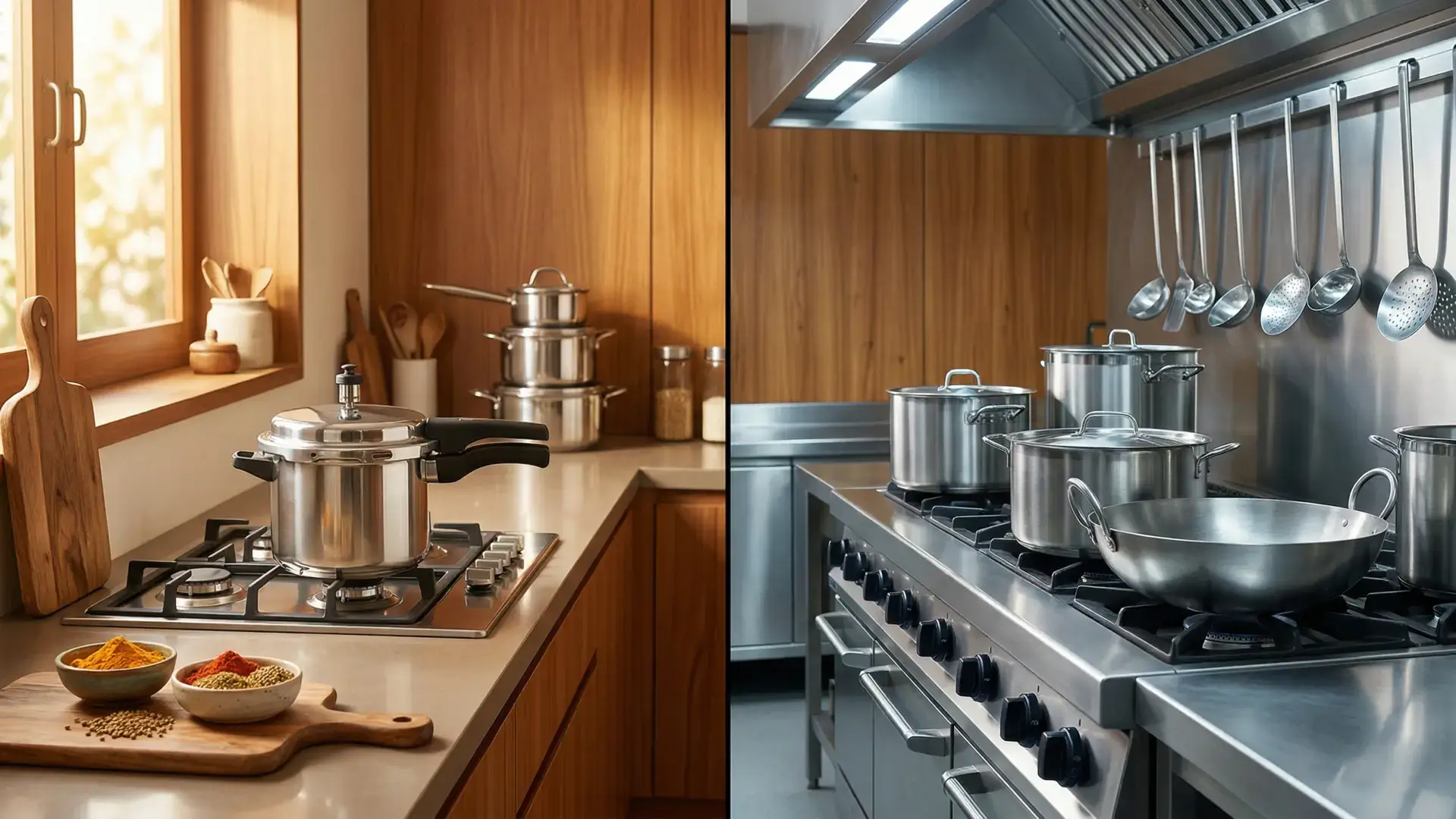
Walk into any five-star hotel kitchen in Kannur or Chennai and you’ll notice one thing immediately: everything looks heavier, shinier, and somehow more serious than what you have at home. That’s not your imagination. India’s kitchenware market was valued at approximately USD 5.23 billion in 2024 and is projected to reach USD 10.89 billion by 2033, growing at a CAGR of 8.5%, according to Grand View Research. A significant chunk of that growth is being driven by the HoReCa (Hotels, Restaurants, Catering) sector, with the National Restaurant Association of India (NRAI) reporting 1,000 to 2,000 new restaurants opening every month in early 2025 alone. All those new establishments need equipment, and the equipment they need is fundamentally different from what you use at home. This guide breaks down exactly why, and helps you figure out whether your kitchen, home or commercial, is equipped the right way.
1. The Cookware Difference: Material, Weight, and Heat Tolerance
The single biggest gap between commercial and home cookware is construction grade. Professional Indian kitchens overwhelmingly use stainless steel cookware, from stockpots and kadais to pressure cookers and saucepans, because it handles high heat, long cooking hours, and strict hygiene standards. But calling it ‘stainless steel’ is only half the story. The grade of that steel matters enormously.
Stainless Steel Grades: 304 vs 316
Home kitchens in India typically use 304 stainless steel (also written as 18/8, meaning 18% chromium and 8% nickel). It handles daily dal, sabzi, and tadka brilliantly. Hotel and restaurant kitchens often step up to 316 or 316L stainless steel, which adds molybdenum to the alloy for extra resistance against acidic ingredients like tamarind, tomato, and vinegar that are simmered in bulk for hours. For a home cook making sambar once a week, 304 is perfectly fine. For a restaurant turning out 200 litres of rasam every morning, 316 is a safer long-term investment.
Thickness: The Number That Actually Matters
The ideal thickness for Indian cooking is 2.5 mm to 3 mm, because the high heat and long cooking times involved in Indian cuisine demand even heat distribution and warp resistance. Home cookware often comes in at 1–2 mm, which is fine for a family of four. Commercial cookware in a hotel kitchen typically starts at 2.5 mm and uses tri-ply construction (stainless + aluminium core + stainless) across the full body, not just the base, to prevent hot spots when cooking at scale.
As cookware specialists note, a home kitchen is a place where cooking follows a personal rhythm and the equipment can be more forgiving, while a commercial kitchen is a fast-paced environment where pans sizzle and chefs move with precision. The cookware has to keep up. In commercial kitchens, cookware is often replaced every few years due to relentless use. At home, a good-quality pressure cooker can whistle perfectly for a decade.
If you’re running a restaurant and catering supplies for your business, investing in tri-ply cookware is one of the best financial decisions you can make: fewer replacements, better cooking consistency, and happier chefs.
2. Crockery: Why Your Hotel’s Plates Are Built Differently
Plates and bowls in a hotel or restaurant are not chosen for aesthetics alone. They have to survive industrial dishwashers running 300 cycles a week, be stackable to save space, resist chipping on hard surfaces, and still look presentable at the 200th dinner service. Home crockery is not designed for any of that.
The Melamine Advantage in Commercial Settings
Melamine crockery is the workhorse of high-volume Indian restaurants, hotel buffets, and corporate canteens. It’s shatterproof, lightweight, dishwasher safe, and available in designs that closely mimic fine porcelain. The key quality marker is the A5 grade: look for 100% A5 stamped on the base, which indicates a dense, high-gloss plate made from pure melamine resin. Cheaper grades (A1/A3) use urea-based fillers, feel lighter, look dull, and are more likely to leach compounds at high temperatures. For a busy restaurant or catering setup, certified A5 melamine dramatically cuts replacement costs because it doesn’t shatter when dropped.
One important caveat: melamine is not microwave safe. The melamine resin absorbs microwave energy instead of letting it pass through to the food. This is not a dealbreaker for most commercial kitchens where food is reheated in proper equipment, but it rules melamine out for home settings where microwave reheating is common.
When Fine Dining Calls for Porcelain
Upscale restaurants and five-star hotels typically use vitrified porcelain or bone china for front-of-house service. Porcelain is fired at higher temperatures than regular ceramics, making it denser and more chip-resistant, with a glossy surface that does not absorb food colours or odours. The trade-off is that it will shatter if dropped, and it’s heavier for serving staff to carry. Many premium Indian hotels therefore use porcelain in the dining room and melamine in the buffet area or staff canteen, mixing both based on the service context.
At home, standard ceramic or glass crockery from a brand like La Opala or Borosil is perfectly appropriate. They’re beautiful, functional, and can handle everyday dishwasher use. They just weren’t built to survive a 12-hour banquet shift.
Planning a commercial setup? Explore Cater Circle’s commercial and hospitality essentials to find the right crockery and tableware for your specific environment, from hospital canteens to wedding catering.
3. Flatware and Utensils: The Grade Nobody Talks About
You’ve probably noticed that the spoons and forks in a good restaurant feel heavier and shinier than your home cutlery. That’s not just a perception. Stainless steel flatware is graded in fractions that reflect chromium and nickel composition, and those numbers tell you a lot about durability and corrosion resistance.
The Four Flatware Grades at a Glance
• 13/0 grade: 13% chromium, zero nickel. Used exclusively for table knives. The lowest grade and most prone to discolouration over time.
• 18/0 grade: 18% chromium, zero nickel. Magnetic (useful for magnetic cutlery catchers), affordable, ideal for cafeterias and quick-service restaurants. Replace roughly every two years in high-volume settings.
• 18/8 grade: 18% chromium, 8% nickel. The sweet spot for upscale casual dining, bistros, banquet halls, and white-collar caterers. Heavier, shinier, and more resistant to bending and staining than 18/0.
• 18/10 grade: 18% chromium, 10% nickel. The premium end. Strongest, most corrosion-resistant, non-magnetic. The choice of fine-dining restaurants and five-star hotels.
Most home cutlery in India falls in the 18/0 or 18/8 range, which is completely fine for domestic use. If you’re setting up a restaurant and want the cutlery to feel substantial and present well, investing in 18/8 or 18/10 is worth the premium. It also means fewer replacements, which matters when you’re buying in bulk.
Size and Scale: The Obvious (But Often Missed) Difference
Beyond grade, the most obvious difference between commercial and home utensils is size. Ladles, serving spoons, and stockpots in a hotel kitchen are sized for volume, not convenience. A home cook doesn’t need a 30-litre pressure cooker, but a hotel banquet kitchen serving 500 guests for a sadya absolutely does. This is why choosing the right size for your context matters as much as choosing the right material.
Quick Reference: Hotel Kitchen vs Home Kitchen at a Glance
| Factor | Home Kitchen | Hotel / Restaurant Kitchen |
| Material grade | 304 SS or coated non-stick | 316 SS, heavy-gauge aluminium |
| Cookware thickness | 1–2 mm typical | 2.5–3 mm+ (tri-ply standard) |
| Crockery type | Ceramic, porcelain, glass | Melamine (A5), vitrified porcelain |
| Flatware grade | 18/0 or 18/8 SS | 18/8 or 18/10 SS |
| Volume per day | 3–5 meals | 100–1,000+ covers |
| Replacement cycle | 5–10 years | 2–5 years (heavy use) |
| Regulatory standard | BIS ISI mark (mandatory from 2024) | BIS + FSSAI + HACCP compliance |
4. Hygiene Standards and Regulatory Compliance
This is where the gap between commercial and home kitchens is most stark, and it’s not just about cleanliness habits. It’s about legal requirements.
India’s Ministry of Commerce and Industry approved the Cookware and Utensils Quality Control Order in 2024, making the BIS ISI mark mandatory on all stainless steel and aluminium utensils sold in the country from September 2024 onwards. This applies to both home and commercial products, but commercial kitchens face an additional layer of compliance through the FSSAI.
Every Indian commercial kitchen must comply with the Food Safety and Standards Act (FSSA), which outlines stringent requirements covering kitchen design, equipment standards, food storage, and hygiene practices. This includes adhering to HACCP (Hazard Analysis and Critical Control Point) standards, conducting risk assessments every six months in NABL-accredited laboratories, and maintaining detailed records of food handling and temperature control throughout the supply chain. A home kitchen simply has none of these obligations.
What this means practically for equipment: commercial kitchen utensils and surfaces must be made of non-toxic, impermeable, easily cleanable materials. Floors, walls, and food-contact surfaces must be smooth and free of crevices where bacteria can accumulate. Equipment must be placed away from walls to allow inspection. The materials you buy matter legally, not just functionally.
If you’re setting up a restaurant, cloud kitchen, or catering business and need equipment that’s already compliant with these standards, visiting Cater Circle’s home kitchen section for domestic needs or the commercial section for professional-grade supplies gives you access to brands already tested to BIS and food-grade specifications.
5. Cater Circle: Bridging Both Worlds in Kannur
One thing that trips up a lot of business owners and home cooks alike is that they don’t know where to physically see, touch, and compare these options. Online specs only tell you so much. Cater Circle in Kannur, Kerala, operates as a sister concern of Popular Stores, with roots going back to 1943. The store carries products across the full spectrum: home kitchen essentials, restaurant and catering supplies, commercial hospitality equipment, and a gifting studio for branded crockery.
As Abdullah Shafeeque, one of their customers, noted in a five-star review:
“Cater Circle has an excellent selection of crockery. The staff are friendly and very helpful, which makes the shopping experience pleasant.” Mohammed Riza pointed to their after-sales service as a differentiator: “Their after-sales service was excellent, and they helped me with gas refilling quickly and efficiently.”
The brands stocked at Cater Circle, including Prestige, La Opala, Milton, Cello, Tefal, and Yera, cover both home and commercial-grade needs. Whether you’re a newlywed equipping a first kitchen or a hotelier sourcing 200 melamine dinner sets, the range is there.
FAQ: Hotel vs Home Cookware in India
Q1. Can I use commercial-grade cookware in my home kitchen?
Yes, and many serious home cooks do. Tri-ply stainless steel cookware designed for commercial use works beautifully at home. The trade-offs are higher upfront cost and heavier weight. But if you cook frequently and want durability, it’s a worthwhile upgrade. Brands like Prestige (available at Cater Circle’s home kitchen section) offer tri-ply ranges that bridge both worlds.
Q2. What is the difference between A5 and regular melamine crockery?
A5 melamine is made from 100% melamine resin, giving it a dense, high-gloss finish and superior durability. Regular or low-grade melamine (A1/A3) often uses urea-based fillers, which are cheaper but more likely to deteriorate with heat and dishwasher cycles. For any commercial use, always ask for A5 certified products.
Q3. What flatware grade should a mid-range restaurant in India use?
18/8 stainless steel flatware is the ideal choice for most mid-range restaurants, bistros, and banquet halls in India. It offers a good balance of shine, weight, durability, and price. Fine-dining establishments should consider stepping up to 18/10.
Q4. Is BIS ISI certification mandatory for kitchen utensils in India?
Yes. Since September 2024, the Bureau of Indian Standards (BIS) ISI mark is mandatory on all stainless steel and aluminium utensils sold in India under the Cookware and Utensils Quality Control Order 2024. When buying, always check for the ISI mark as a minimum quality guarantee.
Q5. Where can I buy both home and hotel-grade kitchen supplies in Kannur?
Cater Circle at Parakkandy, Manjapalam, Kannur, is one of the few stores in the region that stocks the complete range, from home kitchen utensils to commercial-grade cookware, crockery, chafing dishes, and customised branded tableware. Their customised gifting studio also handles corporate gifting with branded bowls, mugs, and plates if your hotel or restaurant needs branded tableware. Contact them at +91 702 557 6666 or visit catercircle.in.