
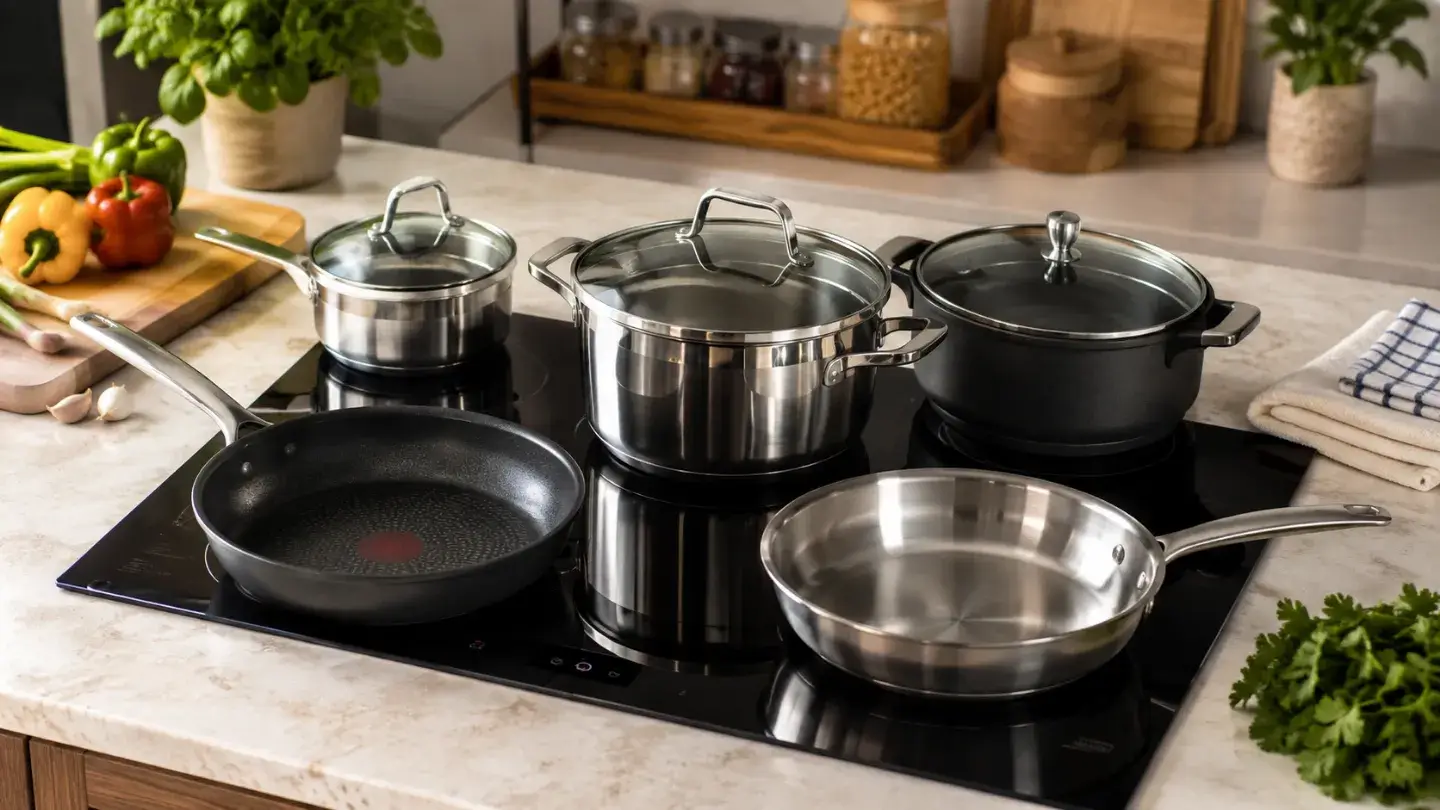
You finally bought the induction cooktop. Maybe the LPG cylinder ran out one too many times, maybe you read our induction cooktop vs gas stove comparison and decided induction was worth trying. Then you put your favourite kadai on it, pressed power, and got nothing. No heat, no beep, just a flat glass surface staring back at you.
This happens to almost everyone switching to induction for the first time, and it has nothing to do with the cooktop being faulty. It comes down to one thing: cookware for induction cooktops has to be built differently from cookware for gas stoves for electric stoves, and most Indian kitchens are stocked with pans that were never designed for it. This guide walks through exactly what makes cookware induction-compatible, which materials actually work, and what to check before you buy a single saucepan, skillet, or induction cookware set.
How Induction Cooktops Actually Heat Your Cookware
A gas flame heats the air around a pan. An induction cooktop skips that step entirely. Beneath the glass surface sits a copper coil carrying alternating current, which generates a magnetic field. When a pan with a magnetic (ferromagnetic) base sits on that field, it induces a swirling electrical current inside the metal itself, called an eddy current. That current runs into electrical resistance in the metal, and that resistance is what generates the heat — the cooktop surface itself never gets hot; only the pan does.
This is the whole reason cookware compatibility matters so much more on induction than on gas or a standard electric coil. If the metal in your pan’s base isn’t magnetic, the coil has nothing to induce a current into, and the burner simply won’t switch on.
The Magnet Test: Still the Fastest Way to Check
Our induction cooktop vs gas stove comparison already covers the basics of this test, and it’s worth repeating because it solves 90% of buying confusion in ten seconds: take a regular fridge magnet and hold it against the base of the pan. If it grips firmly, the pan will work on induction. If it slides off or barely holds, it won’t, regardless of what the label says.
Pure aluminium, copper, and glass cookware fail this test outright unless a magnetic disc has been bonded onto the base. Cast iron passes easily. Stainless steel is where things get more complicated than most buying guides admit.
Stainless Steel Cookware for Induction: Not All Steel Behaves the Same Way
This is the detail that trips up a lot of buyers of stainless steel cookware for induction cooktops. “Stainless steel” isn’t one material — it’s a family of alloys, and whether a given piece of steel is magnetic depends on its internal crystal structure, not just the fact that it’s stainless.
304-grade steel (also called 18/8, the grade our hotel vs home cookware guide covers for its corrosion resistance) has an austenitic structure that is normally non-magnetic or only weakly magnetic in its standard annealed form. A plain 304 stockpot, on its own, often will not trigger an induction burner at all. Grade 430, by contrast, is a ferritic steel that is strongly magnetic by nature, which is exactly why manufacturers use it for induction cookware.
In practice, most branded induction-compatible cookware solves this with layered construction: a magnetic ferritic disc or plate bonded to the base for the induction coil to grip, sandwiched with an aluminium core for even heat spread, and a food-contact interior in the more corrosion-resistant 304 or 316 grade. This layered approach is why induction-safe stainless steel cookware can be both magnetic at the base and non-reactive where it touches your food — each layer is doing a different job. It also explains why two pans can both say “stainless steel” on the box while only one of them actually works on your cooktop; the magnet test still settles this faster than reading a spec sheet.
What About “All-Metal” Induction Cooktops?
You’ll occasionally see induction cooktops marketed as compatible with “all metal” cookware, including aluminium and copper. Genuine all-metal induction heating is real engineering, but it’s still largely a research-stage technology — published power-control studies on all-metal domestic induction systems are recent, and this capability isn’t standard on the induction cooktops sold across Indian retail today. Unless a specific model’s manual explicitly documents non-ferromagnetic compatibility, treat any “all metal” claim with caution and run the magnet test anyway before you buy new cookware to match it.
Saucepans, Skillets, and Kadais: Choosing by Shape and Base
Once the material checks out, shape becomes the next filter. A saucepan for an induction cooktop needs a completely flat base — even a mild warp creates an air gap that weakens the magnetic coupling and causes uneven heating. The same rule rules out the traditional curved-bottom kadai, which is why our earlier comparison guide notes that gas still wins for dishes cooked in curved-bottom vessels.
Size matters more than most buyers expect too. The base of your pan should roughly match the diameter of the cooking zone: too small and the cooktop may not detect the pan at all; too large and only the portion sitting directly over the coil heats properly, leaving the rim cool. When you’re shopping for the best skillet for an induction cooktop, look for a flat, unwarped base that sits fully within the marked cooking zone rather than overhanging it — a heavier, tri-ply base also resists warping over years of daily use better than a thin single-layer one.
Induction Cookware Sets and Pressure Cookers
If you’re building an induction cookware set from scratch, the pressure cooker is usually the anchor piece in an Indian kitchen, and the good news is that stainless steel pressure cookers are generally the most induction-friendly option available. Our pressure cooker brand guide compares Hawkins, Prestige, and other major brands by material, and stainless steel models are marked “induction compatible” across most of that range, while plain aluminium pressure cookers typically are not unless specifically built with a magnetic base disc. If induction is your primary cooktop, it’s worth checking that any pressure cooker, saucepan, or fry pan in your set carries an explicit induction-compatible marking rather than assuming steel alone guarantees it.
Clearing Up “Induction Plate” Searches
One quick clarification, because it changes what you should actually be shopping for: in India, “induction plate” is commonly used to mean the portable induction cooktop appliance itself, not a dinner plate. If that’s what you’re looking for, you want the appliance aisle, not the crockery aisle — Cater Circle’s home kitchen range stocks induction cookers alongside gas stoves and cooking hobs so you can compare build and wattage in person.
Will Induction-Compatible Cookware Work on Gas or Electric Coil Too?
Yes, and this is one of the better arguments for buying induction-compatible cookware even if you’re not fully committed to induction yet. A flat-bottomed, magnetic stainless steel or cast iron pan works perfectly well on a gas burner or a standard electric coil stove — the induction compatibility is an added capability, not a trade-off. This is exactly the logic behind the hybrid kitchen setup we describe in our induction cooktop vs gas stove comparison: buy cookware that works everywhere, and you’re covered whether you’re cooking on the gas stove today or the induction backup during an LPG delivery delay.
BIS Certification: What’s Actually Mandatory for Stainless Steel Cookware Right Now
This is worth getting right, because the regulatory picture has moved since it was first announced. The Bureau of Indian Standards mandate for kitchen utensils began with a Quality Control Order approved in March 2024, requiring the ISI mark on stainless steel and aluminium utensils.
That order has since been revised: a further notification gazetted on 21 August 2025 brought stainless steel utensils under the updated standard IS 14756:2024, with phased compliance dates of 1 October 2025 for general enterprises, 1 January 2026 for small enterprises, and 1 April 2026 for micro enterprises. In practice, this means that as of today, mandatory ISI certification for stainless steel utensils is now fully in force across enterprise sizes. When buying stainless steel cookware for induction or any other use, checking for the ISI mark remains the simplest way to confirm a manufacturer has met current BIS requirements.
Buying Induction Cookware in Kannur
If you’re outfitting a kitchen for induction cooking, Cater Circle’s home kitchen section in Manjapalam stocks Prestige non-stick cookware, steel utensils, and induction cookers, so you can run the magnet test on stock in person rather than guessing from a product photo online. It’s a straightforward way to avoid the classic first-week induction mistake: buying a beautiful new saucepan that turns out to be plain aluminium underneath.
Frequently Asked Questions
1. How do I know if my existing cookware will work on induction?
Hold a fridge magnet against the base. If it sticks firmly, the pan is induction-compatible. If it doesn’t stick, or barely holds, it won’t heat on an induction cooktop regardless of the material label.
2. Is all stainless steel cookware induction compatible?
No. Plain 304-grade stainless steel is often only weakly magnetic and may not work on its own. Most induction-safe stainless steel cookware uses a bonded magnetic (usually 430-grade) disc at the base specifically for this purpose.
3. Can I use my induction-compatible cookware on a gas stove?
Yes. Flat-bottomed, magnetic cookware works fine on gas and standard electric coil stoves too — induction compatibility adds a capability without removing any.
4. Why doesn’t my pan heat evenly on induction even though it works?
This is usually a size or flatness mismatch. If the pan’s base is much larger or smaller than the cooking zone, or the base has warped slightly, contact with the coil becomes uneven and so does the heating.
5. Is BIS certification mandatory for stainless steel cookware in India right now?
Yes. Following the gazette notification of 21 August 2025, mandatory ISI certification under IS 14756:2024 is now in force across general, small, and micro enterprises as of the phased 2025–2026 deadlines.
6. Where can I check induction cookware in person in Kannur?
Cater Circle in Manjapalam, Kannur, stocks induction cookers, Prestige non-stick cookware, and steel utensils. Call +91 702 557 6666 or visit catercircle.in.