
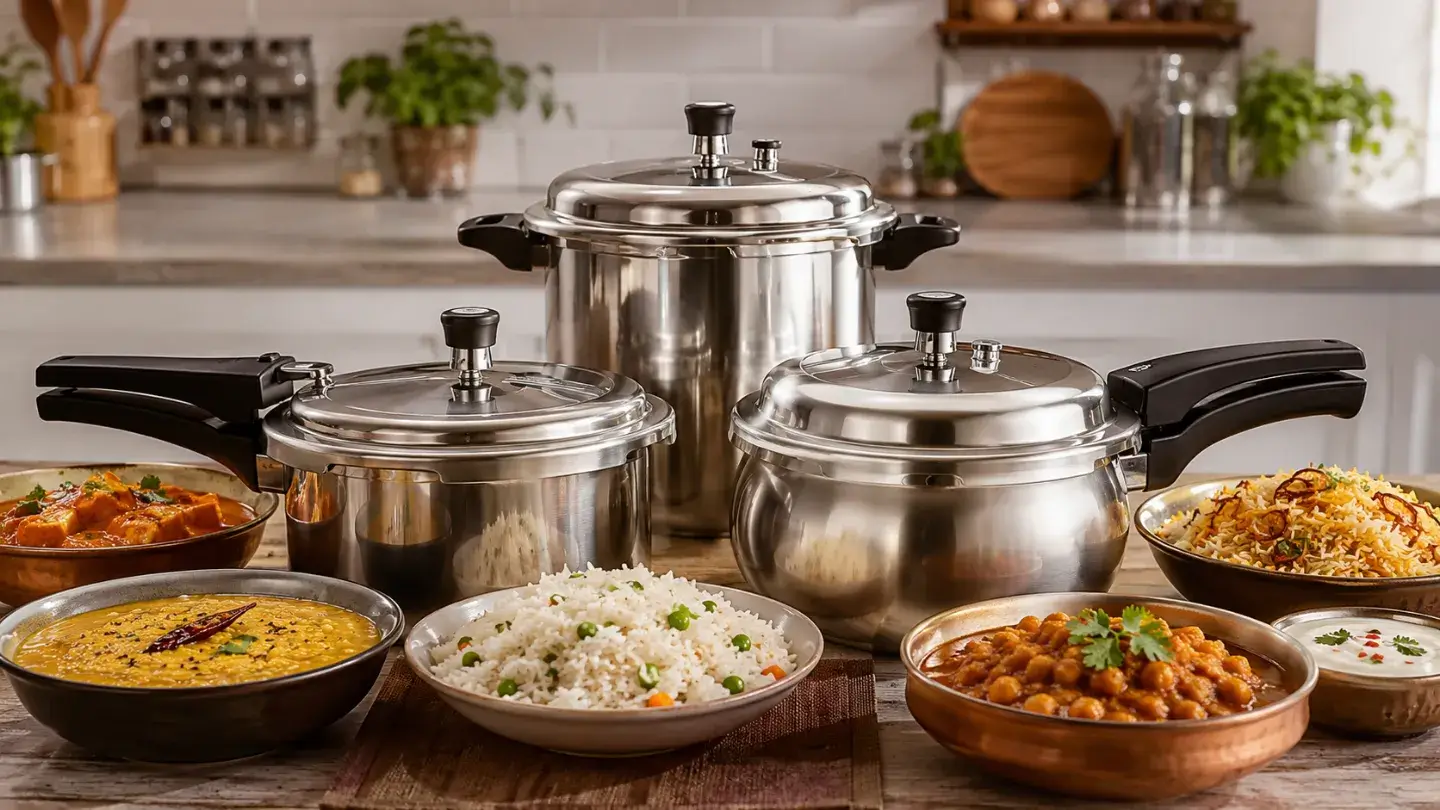
Type “best pressure cooker” into Google and you’ll get a wall of brand comparisons — Prestige versus Hawkins, aluminium versus steel, who has the bigger showroom footprint. If that’s what you’re after, Cater Circle’s pressure cooker brand comparison already covers it in detail: market share, material tradeoffs, and a straight verdict on which brand to buy.
This guide answers a different, more useful question: once you’ve picked a brand, which cooker — what size, what shape, how many whistles — actually suits what you’re putting inside it? A 2-litre cooker that’s perfect for a bachelor’s dal is the wrong tool for Sunday biryani for eight people, and a narrow tall cooker that’s fine for rajma will turn your biryani rice to mush. The dish should drive the decision as much as the brand does.
Why the Dish Matters More Than the Brand
Every pressure cooker sold in India — regardless of brand — has to meet the same government-mandated safety baseline. Domestic pressure cookers are certified under IS 2347:2017, the Bureau of Indian Standards specification that governs everything from the pressure-regulating device to the materials allowed in the gasket, and covers nominal capacities from 1 to 22 litres. Once that safety floor is met, the differences that actually change your cooking outcome are capacity, shape, and how many whistles you give a dish — not which logo is stamped on the lid.
Best Pressure Cooker for Rice and Biryani
Rice and biryani are where shape matters most. A wide, shallow pressure pan gives rice more surface area to spread out and cook evenly, which is why traditional biryani technique consistently favours a broader pan over a narrow, tall cooker — a narrow cooker concentrates the rice into a deeper layer, so the bottom grains overcook while the top stays undercooked. Dassana’s Veg Recipes, a long-running reference for Indian home cooking, sets out the standard method for pressure-cooked biryani rice: soaked basmati, a controlled water ratio, and just one to two whistles before the flame goes off entirely.
Practical rule of thumb for rice-based dishes:
- Plain rice, 2–3 people: 2–3 litre cooker, 1 whistle, natural pressure release
- Biryani, 4–6 people: 5-litre wide pressure pan (not a tall cooker), 1 whistle on low flame, then rest before opening
- Bulk biryani for guests: see the commercial-capacity section further down
If you’re cooking biryani regularly, a dedicated pressure pan is worth the small extra cost over a general-purpose tall cooker — it’s the single biggest factor in whether your rice comes out fluffy or gluey.
Best Pressure Cooker for Dal and Lentils
Dal is the opposite case: shape matters less, but soaking time and whistle count vary sharply by lentil type, and getting this wrong is the most common reason dal comes out either undercooked or overly watery. A detailed cooking-time breakdown from Namma Markt lays out soak times and whistle counts per dal variety, and a separate lentil-specific chart from Eat Healthy 365 confirms the same pattern: denser lentils need meaningfully more time than lighter ones.
| Dal Type | Soak Time | Whistles (Soaked) | Water Ratio |
| Moong dal (split) | Not required, or 15–20 min | 1–2 | 1:2.5 |
| Masoor dal | Not required | 1–2 | 1:2.5 |
| Toor dal | 30 min | 2 | 1:2.5–3 |
| Chana dal | 4–6 hours or overnight | 3–4 | 1:3 |
| Whole green moong | 4–6 hours or overnight | 3–4 | 1:3 |
A soaked lentil generally cooks in roughly 25–30% less time than an unsoaked one, which is worth factoring in if you’re planning dinner around when the cooker will actually be free. For everyday dal in a two- to four-person household, a 3-litre stainless steel cooker is the practical sweet spot — small enough to heat up fast, large enough not to run twice.
Matching Cooker Size to Your Household
Because IS 2347 permits capacities all the way up to 22 litres, “best pressure cooker” genuinely depends on how many people you’re cooking for, not just what’s popular. As a general guide:
- 1–2 people: 2–3 litre cooker for daily dal, rice, and vegetables
- 3–5 people: 5-litre cooker as the everyday workhorse, ideally paired with a wider pressure pan for rice dishes
- Joint families, frequent guests: 7-litre cooker or a second smaller one for simultaneous cooking
- Institutional or catering use: 14–22 litre range, which starts to require a different buying checklist entirely (more on that below)
If you’re deciding between stainless steel and aluminium for your primary cooker, that’s a material question rather than a sizing one, and our full brand-by-brand pressure cooker guide already walks through the tradeoffs in depth. Cater Circle’s home kitchen range in Kannur stocks both stovetop pressure cookers and the wider pans that make a real difference for rice and biryani specifically.
Cooking for a Crowd: Where the Rules Change
Once you’re regularly cooking for 10 or more — a large joint family, a small home catering setup, or an actual restaurant kitchen — the buying calculation shifts entirely. Commercial-volume pressure cookers fall under a separate BIS specification, IS 17870:2022, distinct from the IS 2347 standard that governs household cookers, reflecting the different stress and duty-cycle demands of continuous commercial use. At that scale, the priorities become large capacity (14L and above), stainless steel for hygiene compliance, and a supplier who can service a gasket failure quickly rather than a mail-order replacement part. Cater Circle’s catering equipment checklist and restaurant and catering supplies range cover this bulk-cooking category in more depth, including the broader equipment list beyond just the cooker itself.
What About Electric Pressure Cookers, Multi-Cookers, and Instant Pot?
If you’ve searched for the “best electric pressure cooker” or “best instant pot,” it’s worth understanding what you’re actually comparing before you buy, because it’s a genuinely different appliance category from the stovetop cookers covered above — not just a powered version of the same thing.
An electric pressure cooker (often marketed as a multi-cooker) combines a pressure-cooking function with automated presets for slow cooking, rice, and sometimes yogurt-making, and it regulates pressure and temperature electronically rather than through a manual whistle. Because it’s an electrical appliance rather than a stovetop vessel, it doesn’t fall under the IS 2347 pressure-cooker standard at all — it’s governed by India’s general electrical-appliance safety framework instead, built around IS 302 (Part 1) and its IEC 60335-1 equivalent, the same base standard that covers most household electrical appliances.
Where electric cookers do have a genuine efficiency case is energy use. A white paper from the India Smart Grid Forum found that LPG stove thermal efficiency runs around 55–57%, against 74–84% for electric cooking appliances, with electric pressure cookers specifically cited as among the lowest-energy-consuming cooking technologies available. For households already on electric or induction cooking — see our induction cooktop vs gas stove comparison if you’re weighing that switch — an electric pressure cooker fits naturally into that setup.
That said, this is a category Cater Circle doesn’t currently stock, so we can’t give you a genuine buying recommendation the way we can for stovetop cookers. If you’re set on an electric multi-cooker, treat presets and safety-mechanism count (lid lock, pressure-release valve, anti-blockage vent) as your comparison points, and verify BIS marking on whichever unit you choose, since electrical safety certification is mandatory here just as it is for stovetop cookers. For the stovetop side of your kitchen — the cooker that still does most of the daily rice, dal, and biryani work in an Indian household — Cater Circle’s range and the brand guide above are the more direct fit.
Frequently Asked Questions
1. How many whistles does rice need in a pressure cooker?
For plain rice, 1 whistle followed by natural pressure release is standard. Biryani rice is typically cooked on low flame for just 1 whistle to avoid overcooking, since the rice continues to soften from residual heat.
2. Do I need to soak dal before pressure cooking?
It’s optional for light dals like moong and masoor, but strongly recommended for chana dal and whole lentils, which can take 3–4 whistles unsoaked versus roughly a quarter less time when soaked for several hours.
3. What size pressure cooker do I need for a family of four?
A 5-litre cooker covers daily cooking for four to five people. Add a wider pressure pan if biryani or pulao is a regular dish, since capacity alone doesn’t fix the rice-texture issue a narrow cooker creates.
4. Is an electric pressure cooker better than a stovetop one for Indian cooking?
Electric cookers are more energy-efficient and require less monitoring, but most models need manual adjustment to hit the exact texture Indian recipes expect for rice and dal. Stovetop cookers remain the default in most Indian kitchens for that reason.
5. Does a pressure cooker need to be BIS certified?
Yes. Domestic stovetop pressure cookers must carry ISI certification under IS 2347:2017, and electric pressure cookers must meet India’s general electrical-appliance safety standard. Always check for the BIS mark regardless of which type you buy.