
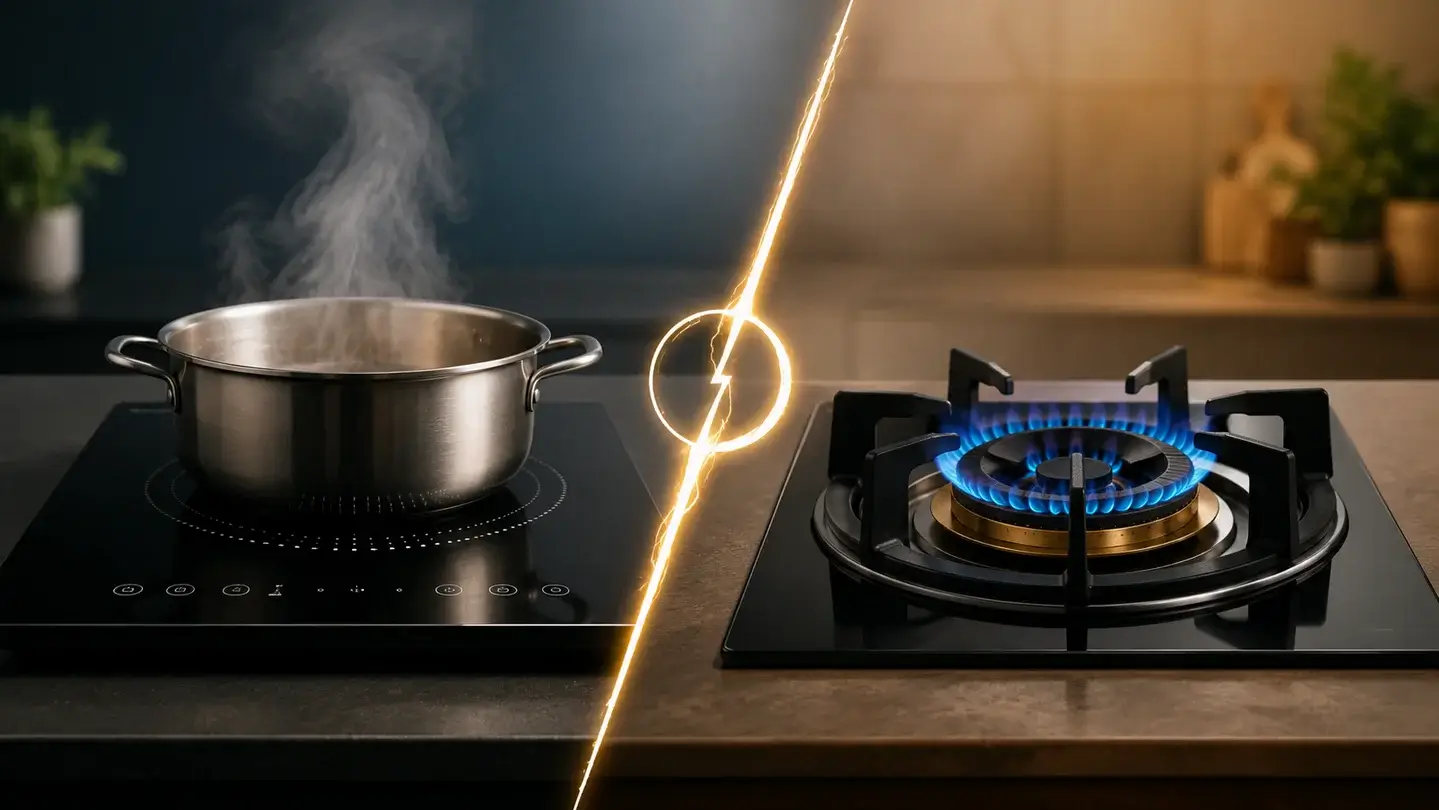
If you have stood in a kitchen showroom in Kannur wondering whether to pick a gas stove or an induction cooktop, you are not alone. Every household that has waited days for an LPG cylinder refill has asked this exact question: is an induction stove better than gas, or is the flame still worth keeping? The honest answer is that neither wins on every count. This guide breaks down the induction cooktop vs gas stove decision the way it actually plays out in an Indian kitchen — cost, safety, speed, and what your favourite dishes need.
How Each One Actually Heats Your Food
A gas stove burns LPG or PNG at the burner, and the flame heats the air around your vessel before that heat reaches the food. An induction cooktop works differently. It uses an electromagnetic coil under a glass surface to generate heat directly inside the base of the cookware itself, so very little energy escapes into the room. This one mechanical difference explains almost every other difference on this list — efficiency, kitchen temperature, and even which vessels you can use.
Energy Efficiency: The Real Numbers
This is where the induction cooktop vs gas stove debate is least ambiguous. Government-recognised efficiency bands for induction hobs sold in India show that even entry-level models transfer 70 to 76 percent of input energy to the cookware, while premium dual-coil and multi-coil designs reach 82 to 88 percent efficiency. Gas stoves, by comparison, lose more than half their energy heating the surrounding air rather than the pan, largely because there is a physical gap between flame and vessel base. That efficiency gap is the main reason induction cooking vs gas cooking almost always favours induction on running cost, even though the appliance itself often costs more upfront.
What This Costs You in Kannur and Kerala
Numbers matter more than percentages when you are the one paying the bill. As of mid-2026, a standard 14.2 kg domestic LPG cylinder costs around ₹941.50 in most Indian cities, having risen roughly ₹89 over the preceding twelve months.
On the electricity side, Kerala’s domestic tariff is telescopic: KSEB charges roughly ₹3.35 per unit for your first 50 units a month, rising through the slabs to ₹8.50 per unit for consumption between 201 and 250 units, under the tariff order effective through March 2027. Because induction wastes so little heat, a family cooking two meals a day on induction typically uses fewer kWh than the LPG-equivalent energy a gas stove burns for the same food — even after Kerala’s slab increases are factored in.
It is worth noting that the Government of India continues to subsidise domestic LPG for PMUY beneficiaries, bringing the effective cylinder cost down to about ₹553, which narrows the gap considerably for subsidised households.
Speed: Which One Actually Cooks Faster
Induction consistently wins the boil test. Multiple independent comparisons find induction brings six cups of water to a boil in roughly five minutes, against about eight minutes on a gas stove, simply because heat is generated inside the vessel rather than transferred through it. For chai, dal, or a quick tadka, that difference adds up over a week of daily cooking.
Safety: What the Research Actually Shows
This is the part of the induction vs gas stove pros and cons list that gets the least attention in showroom conversations, but it matters. A nationwide, peer-reviewed Stanford-led study measuring both indoor and outdoor pollution sources found that replacing gas stoves with electric alternatives can cut nitrogen dioxide exposure by over a quarter on average, and by as much as half for the heaviest stove users.
The same research group found that typical gas stove use raises indoor nitrogen dioxide levels to roughly three-quarters of the threshold the World Health Organization considers unsafe for outdoor air, and that this exposure can linger for hours after the stove is switched off. This research was conducted in the US, but the underlying combustion chemistry, and the case for good kitchen ventilation with any gas appliance, applies anywhere gas is burned indoors. Beyond air quality, induction’s cool-to-touch surface and automatic pan-detection shut-off make it a genuinely safer choice around children and elderly family members, while gas retains the small but real risks of leaks and open flame.
Will Your Cookware Actually Work?
This is the single biggest practical objection to switching, and it is a fair one. Induction cooktops only heat cookware that is magnetic at the base — cast iron and most stainless steel qualify, while pure aluminium, copper, and glass do not unless a magnetic layer has been bonded on.
The most reliable way to check is the magnet test: hold a fridge magnet against the base of your pan, and if it sticks firmly, the cookware is induction compatible. If you are building or upgrading a kitchen with this in mind, our hotel vs home cookware guide covers stainless steel grades and thickness in more depth, both of which affect how evenly a pan performs on either surface. Gas, by contrast, works with every vessel shape and material, including curved kadais and tawas that many traditional Kerala dishes depend on.
BIS, BEE, and What’s Changing in Regulation
India’s Bureau of Energy Efficiency has run a voluntary star-labelling programme for induction cooktops since 2019, rating models from one to five stars based on cooking efficiency. Mandatory labelling for models above a set wattage was originally due in 2026, but the government has pushed this deadline back by six months to January 1, 2027, to give manufacturers more time to comply. In practical terms, this means star ratings on induction cooktops are still voluntary today, so it is worth checking a model’s rated efficiency band rather than assuming every unit on the shelf has been certified.
Which Traditional Dishes Suit Which Stove
Gas still has the edge for anything that depends on direct flame contact: phulkas puffed straight over the burner, tempering (tadka) that needs instant heat adjustment, and dishes cooked in curved-bottom kadais. Induction performs better for anything that benefits from steady, precise heat control — simmering curries, boiling milk without scorching, and one-pot dishes where you want to walk away without babysitting the flame. This is exactly why so many Kerala households are moving toward a hybrid kitchen rather than picking one exclusively.
Making the Switch, or Going Hybrid
Most Kannur households do not need to choose one appliance and abandon the other. A common, practical setup is a 2-burner gas stove for roti, tadka, and pressure cooking, paired with a portable induction cooktop for daily boiling, simmering, and backup cooking during LPG delivery delays.
If you are outfitting a kitchen from scratch, Cater Circle’s home kitchen range in Kannur stocks both gas stoves and induction cookers from established brands, so you can compare build quality and burner output in person rather than guessing from a product photo.
If you already own a pressure cooker and are wondering whether it will work on induction, our pressure cooker brand guide breaks down which materials are induction-compatible across the major Indian brands.
For Restaurants, Caterers, and Hotels
The calculation shifts for commercial kitchens. High-output multi-burner gas ranges remain the backbone of most Indian restaurant kitchens because chefs need instant, visible flame control across several dishes at once. That said, induction is steadily entering commercial setups for specific tasks — holding curries at temperature, catering stations with limited LPG access, and menu items that benefit from precise, unattended simmering. Our restaurant kitchen equipment guide covers how commercial gas ranges and induction cooktops are typically combined in a working Indian kitchen, including burner-count recommendations by kitchen size.
Our Verdict
There is no single winner in the gas stove vs induction stove which is better question — it depends on your household. For a small family in an apartment who values a cooler kitchen, lower running costs, and easy cleaning, induction is increasingly the smarter primary choice. For larger families who cook multiple dishes at once, rely on curved traditional cookware, or want a stove that works during a power cut, gas remains hard to beat. For most Kannur households in 2026, the realistic answer is both: a gas stove as the workhorse, and an induction cooktop as the efficient, safer backup.
Frequently Asked Questions
1. Is an induction stove better than a gas stove for daily Indian cooking?
For everyday tasks like boiling, simmering, and reheating, induction is generally faster and cheaper to run. For phulkas, tadka, and dishes needing curved cookware, gas still performs better.
2. What is best, induction or gas cooktop, for a small kitchen?
Induction suits small and rental kitchens well since a portable unit needs minimal counter space, produces no combustion fumes, and needs no cylinder storage.
3. Which is best, stove top gas or induction, for a big joint family?
Gas usually wins here. Large families cooking multiple dishes simultaneously benefit from gas’s flexibility across cookware types and its independence from electricity supply.
4. Does all my existing cookware work on induction?
Not automatically. Cast iron and most stainless steel work; pure aluminium, copper, and glass typically do not unless they have a bonded magnetic base. A simple magnet test at home tells you in seconds.
5. Is a BEE star rating mandatory for induction cooktops in India right now?
No. Star labelling for induction hobs is currently voluntary in India, with mandatory labelling for higher-wattage models pushed to January 1, 2027.
6. Where can I see and compare gas stoves and induction cooktops in Kannur?
Cater Circle in Manjapalam, Kannur, stocks both gas stoves and induction cookers so you can compare burner output and build quality before buying. Call +91 702 557 6666 or visit catercircle.in.