
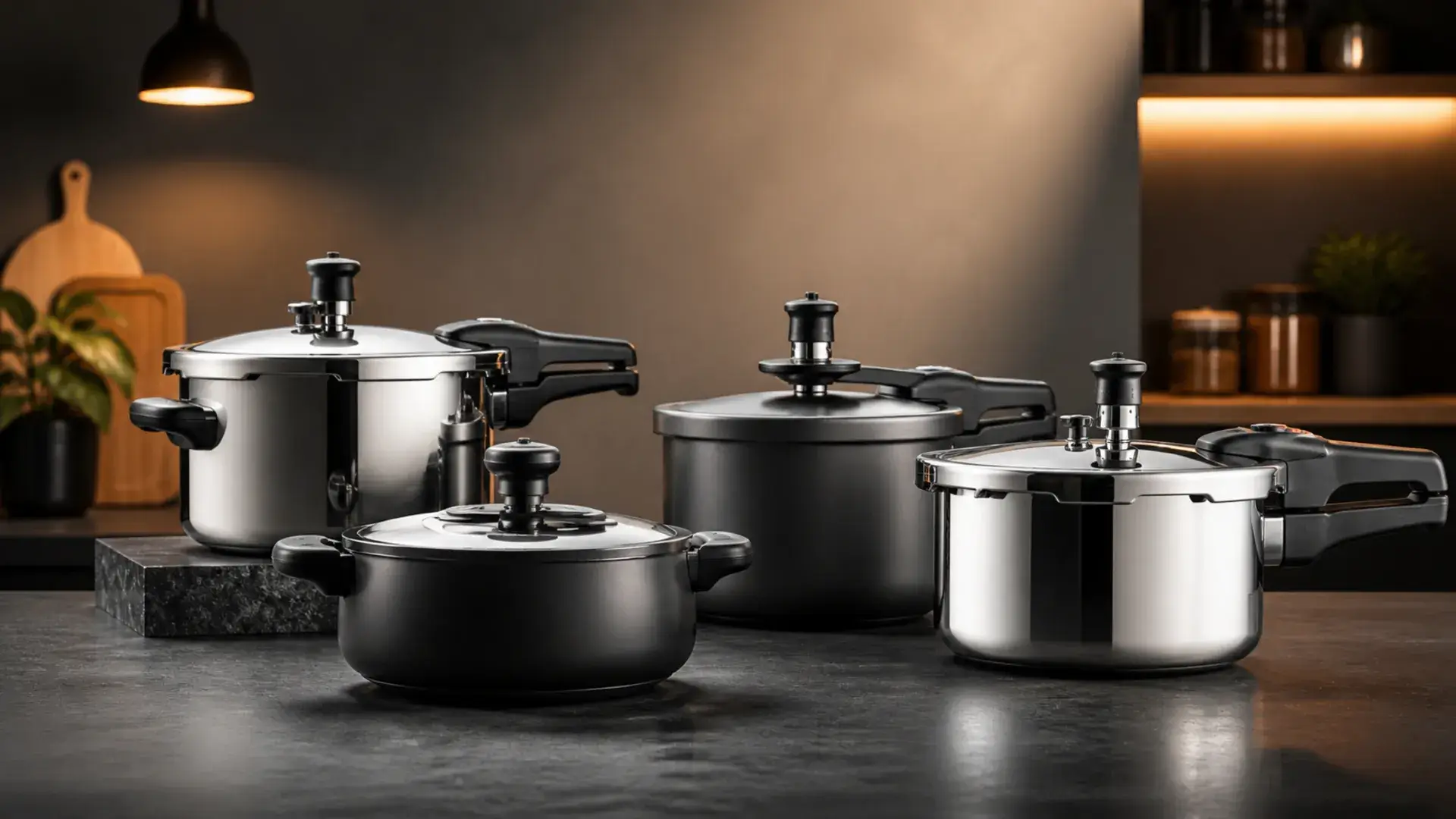
You already know the sound. That insistent whistle cutting through every Indian afternoon, letting you know dal is almost done and someone’s probably walking through the front door any second. The pressure cooker isn’t just a kitchen appliance in India — it’s practically cultural infrastructure. But standing in front of three shelves of cookers at a shop like Cater Circle, wondering whether to pick up Hawkins, Prestige, or something else entirely, is a genuinely confusing experience.
This pressure cooker brand guide cuts through that confusion. We’ll cover which brand pressure cooker is best in India, what material actually matters for your cooking style, what the market data says about who dominates this category, and how to match your pick to your actual kitchen needs.
Why the Pressure Cooker Still Runs the Indian Kitchen
The pressure cooker’s dominance in Indian cooking is no accident of habit. Reducing cooking time by around 70% compared to conventional methods while simultaneously cutting fuel consumption — that’s a practical trifecta of time, money, and energy savings that no other single appliance replicates.
India is both the largest producer and consumer of pressure cookers in the Asia-Pacific region, which itself commanded a 66.84% share of the global market in 2024. The domestic Indian market is projected to reach USD 611.3 million by 2031, growing at a CAGR of 8.9%. That growth isn’t speculation — it maps directly to rising urbanisation, busier households, and a steady shift toward premium materials.
South India, where rice and pressure-cooked curries are meal staples, accounts for roughly 35% of national pressure cooker industry revenue. If you’re in Kerala, that context matters: your cooker probably works harder than the national average.
The Indian Pressure Cooker Market: Who Actually Leads?
The honest answer to “which is the best pressure cooker company in India” starts with market data, not brand loyalty.
Prestige and Hawkins together account for more than 50% of the Indian pressure cooker market. Prestige holds approximately 45–48% market share, making it the outright segment leader. Hawkins follows with around 32–35%.
What’s interesting is how they got there. Prestige invests heavily in advertising — around 7% of revenue compared to Hawkins’ 3–4% — yet Hawkins keeps pace largely through word-of-mouth. When a brand maintains a third of a competitive market without heavy ad spend, that says something real about product satisfaction.
Beyond the top two, brands like Pigeon (owned by Stovekraft since 1999), Butterfly, Vinod Cookware, Bajaj, and Wonderchef compete for the remaining share. Globally, Hawkins and TTK Prestige are among the top five manufacturers by combined market share, alongside Chinese giants Midea and Supor.
The Two Giants: Prestige vs Hawkins
TTK Prestige: The Market Leader
Prestige’s story begins in 1955 when the TTK Group was incorporated in Madras. In 1959, the company began manufacturing pressure cookers in technical collaboration with the UK’s Prestige Group, essentially introducing the appliance to the Indian market at scale. That 65-plus-year head start is baked into the brand’s DNA.
Today, Prestige has over 700 exclusive stores across India and a product range that stretches far beyond pressure cookers into gas stoves, induction cooktops, mixer grinders, and non-stick cookware. Their home kitchen essentials lineup illustrates exactly this full-kitchen approach.
Their most notable recent innovation is the Svachh lid — India’s first spill-control pressure cooker design, with an indented lid that catches the foam and liquid that typically bubbles over when cooking rice. It’s the kind of practical problem-solving that keeps Prestige relevant with younger home cooks.
Prestige pressure cookers are available in aluminium, stainless steel, and hard anodized aluminium, across dozens of capacities and shapes including pan-style, handi (curved), tall, and the Nakshatra inner-lid series.
Hawkins: The Durability Benchmark
Hawkins was founded in 1959 by H.D. Vasudeva — an entrepreneur who rebuilt his life after India’s Partition — with an initial capital of just Rs 20,000, in technical collaboration with L.G. Hawkins of England. By 1986, Hawkins Cookers had acquired the trademark outright and established a fully independent Indian identity.
The brand has since sold over 110 million pressure cookers globally and exports to more than 65 countries. Every Hawkins cooker is certified by Underwriters Laboratories (UL) in the USA — an independent global safety testing body — and comes with a five-year guarantee.
Hawkins’ signature design is the inside-fitting lid, which physically cannot be opened until internal steam pressure drops to a safe level. The brand compares this to a jetliner door — a slightly dramatic analogy that still makes the safety point clearly. Their Contura and Futura models are the most popular, with the stainless steel Contura consistently rating at the top of independent review comparisons.
The main tradeoff with Hawkins is ergonomics — the locking mechanism takes some getting used to, and the design has changed little over the decades. Some users find Prestige’s outer-lid system more intuitive on first use. But once you’re past that learning curve, Hawkins cookers are widely regarded as the most durable option available in the Indian market.
Other Strong Contenders
Pigeon by Stovekraft
Pigeon has built its reputation on making reliable, budget-friendly cookers that handle daily Indian cooking without drama. Part of Stovekraft since 1999, the brand focuses on practical design and competitive pricing. If the goal is a functional cooker for regular use without a premium spend, Pigeon is a legitimate choice rather than a compromise.
Vinod Cookware
Vinod has carved out a niche with its sandwich-bottom and triply construction — intelligent heat-conductive technology that heats faster, maintains steady pressure, and avoids hotspots. It sits at a slight premium over Hawkins and Prestige but offers a genuinely premium build for buyers willing to invest.
Butterfly, Bajaj, and Wonderchef
Butterfly is particularly strong in stainless steel cookers and has a loyal following in South India. Bajaj remains a trusted household name for entry-level appliances. Wonderchef — backed by celebrity chef Sanjeev Kapoor — skews toward modern aesthetics and premium non-stick cookware but also offers pressure cookers for the style-conscious buyer.
Choosing by Material: What Indian Cooking Actually Demands
The “which brand pressure cooker is best” question often comes down to a hidden sub-question: which material? Here’s the honest breakdown for Indian kitchens.
Aluminium: The Budget-Friendly Workhorse
Aluminium has been the default for Indian kitchens for generations — and with good reason. It heats rapidly, builds pressure fast, cooks rice and dal efficiently, and costs significantly less than steel. The lightweight build is easier to handle when full of food.
The concerns are real though. Aluminium reacts with acidic and salty foods, which matters when you’re cooking tomato-heavy curries or tamarind-based dishes. Repeated exposure can cause the metal to leach into food. It also oxidises over time, giving the cooker that dull, greyed look that makes it look older than it is.
Stainless Steel: The Long-Term Investment
Stainless steel cookers are non-reactive, dishwasher-safe, and don’t leach metals into food regardless of what you’re cooking. Stainless steel pressure cookers typically last 15 to 20 years with proper care, compared to 8 to 12 years for standard aluminium models. They also hold their appearance far better over years of daily use.
The tradeoff is price — stainless steel cookers can cost roughly twice as much as their aluminium equivalents — and slightly slower heat-up time. Modern stainless steel models with sandwich or triply bases have largely resolved the heat distribution problem.
Hard Anodized Aluminium: The Middle Path
Hard anodized aluminium is aluminium that has undergone an electrochemical process that creates a dense, non-reactive surface layer. The anodization removes the reactivity concerns of bare aluminium while retaining its heat conductivity and lightweight advantages. Hard anodized cookers are scratch-resistant, non-stick, and generally more durable than standard aluminium.
The downside: they cost more than standard aluminium and cannot be used with abrasive cleaners. Prestige and Hawkins both offer strong hard anodized ranges.
Quick Comparison Table
| Aluminium | Stainless Steel | Hard Anodized | |
| Heat-up speed | Fastest | Moderate | Fast |
| Durability | 8–12 years | 15–20 years | 10–15 years |
| Reactivity with food | Reacts with acids | Non-reactive | Non-reactive |
| Induction compatible | Some models only | Most models | Some models |
| Price range | Budget | Premium | Mid-range |
Buying for a Restaurant or Catering Kitchen? It’s a Different Calculation
Commercial kitchens in India run pressure cookers at a completely different intensity to homes. A restaurant or catering operation might use a cooker six to eight hours per day, five to seven days a week. That changes every buying criterion.
For restaurants and catering operations, the priorities shift to: large-capacity models (14L, 18L, 22L), stainless steel construction for hygiene and durability, ISI certification, and after-sales service availability in your local area. Hawkins produces dedicated commercial-sized models in its Big Boy range. Prestige offers institutional options as well.
Commercial kitchens often benefit from buying in bulk — and having a local supplier who understands institutional requirements makes a real difference when a gasket fails on a Saturday night before a wedding catering job.
The No. 1 Pressure Cooker Brand in India: A Practical Verdict
If you need the single most direct answer to which Indian pressure cooker is best: it depends on what you value most.
- Best overall build and durability: Hawkins — consistently rated higher for longevity, with the inside-fitting lid design and UL certification making it particularly strong on safety.
- Best range and innovation: Prestige — widest variety of designs, materials, and price points; the Svachh spill-control lid is a genuine quality-of-life upgrade for rice cookers.
- Best value for money: Pigeon — reliable daily use without premium spend.
- Best premium option: Vinod or Stahl — triply or sandwich-bottom construction for serious home cooks.
For most Indian households buying a cooker to last a decade or more, the Hawkins Contura or Prestige Deluxe Alpha in stainless steel are the benchmarks. Both cost more than a budget aluminium cooker upfront, but the longevity and food-safety benefits make the math work out over time.
At Cater Circle in Kannur, our home kitchen section stocks both Prestige and a curated range of other trusted brands so you can compare builds in person before buying — something a product description page can’t fully replicate. The difference between a gasket that lasts two years and one that lasts ten becomes obvious when you’re holding the two cookers side by side.
Safety Features to Look for in Any Brand
Whichever brand you land on, these are the safety features worth confirming before you buy:
- Pressure release valve: lets excess steam escape safely during cooking
- Gasket release system: automatically releases pressure if the gasket seat is blocked
- Pressure-lock lid: cannot be opened while internal pressure is above safe level
- ISI mark: the Bureau of Indian Standards certification that confirms the cooker meets national safety requirements
- UL listing: Hawkins-specific; Underwriters Laboratories USA safety certification for export-quality build standards
The commercial and hospitality kitchenware segment requires additional compliance — particularly for food-contact surfaces and commercial-grade pressure ratings — so institutional buyers should look for both ISI and BIS marks and confirm their supplier understands those requirements.
Frequently Asked Questions
1. Which is the best pressure cooker brand in India?
Prestige leads the market with approximately 45–48% share, making it the most popular brand by volume. Hawkins is the stronger choice for durability and safety design. For most home kitchens, either is an excellent choice — your decision comes down to whether you prioritise range and innovation (Prestige) or long-term build quality (Hawkins).
2. Which is better: Hawkins or Prestige?
Independent long-term testing consistently rates Hawkins higher for durability, with users reporting fewer replacement parts needed over a decade of use. Prestige scores higher for variety, ease of use on first purchase, and design innovation. Both are manufactured in India and have extensive service networks.
3. Is a stainless steel pressure cooker better than aluminium for Indian cooking?
For curries, tamarind-based dishes, and acidic preparations, stainless steel is the safer choice as it doesn’t react with food. Aluminium is perfectly fine for dal, rice, and less acidic dishes, and heats faster. Hard anodized aluminium offers a middle ground: non-reactive with the heat conductivity of aluminium.
4. What size pressure cooker do I need?
A 3-litre cooker handles a family of two to three. A 5-litre model covers four to five people for everyday meals. Larger families or anyone who batch-cooks regularly should look at 7-litre models. Commercial operations typically use 14L to 22L models.
5. What is the No. 1 pressure cooker brand in India?
By market share, TTK Prestige holds the top position in India’s stovetop pressure cooker category. Hawkins holds second place and is widely regarded as the leader in safety and build quality. Both brands have been manufacturing pressure cookers in India since 1959.
6. Are branded pressure cookers worth the premium over unbranded options?
Yes — consistently. A well-made branded pressure cooker like Hawkins or Prestige comes with a five-year guarantee, nationwide service centres, and standardised spare parts (gaskets, valves, handles) that are available everywhere. Unbranded or cheap imported cookers frequently fail on gasket quality and pressure regulation, which is a safety risk, not just an inconvenience.
Browse Cater Circle’s home kitchen range in Kannur:
Home Kitchen Essentials — Cater Circle