
India’s catering sector is growing fast. According to IMARC Group, the market was valued at USD 5.10 billion in 2024 and is projected to reach USD 7.39 billion by 2033. That growth is driven by weddings, corporate events, and the steady expansion of the hospitality sector — and every rupee of it runs through kitchens that need the right tools.
If you’re starting a catering business or scaling an existing one, the equipment list is where most people either get it right or spend the next two years fixing expensive mistakes. Too little, and you can’t service volume. Too much, and you’ve locked up capital in gear you don’t use. This guide breaks down the full catering equipment requirements for Indian operations — from the prep kitchen to the buffet line — with a focus on what actually matters in practice.
Why Getting Your Equipment List Right Is Non-Negotiable
The FSSAI Guidance Document for the Catering Sector requires that food flow in catering operations move in one direction — from receiving to storage to preparation to cooking to packaging or serving — with no backtracking that could cause contamination. That single requirement shapes the entire equipment layout of a professional catering kitchen. You can’t improvise your way around it with mismatched gear.
Beyond compliance, the right equipment directly affects your ability to serve at volume, maintain food temperature safely, and keep your staff efficient. ClearTax’s guide to starting a catering business in India estimates the average startup investment at around Rs. 20 lakh, covering kitchen rent, licenses, transport, and equipment. That’s a meaningful budget — and your equipment decisions determine whether it’s money well spent or money chasing problems.
Here’s the full breakdown, organised by function.
1. Core Cooking Equipment
The cooking section is your highest-priority investment. Everything else serves what comes out of here.
Commercial Gas Ranges and Burner Stoves
High-output commercial burners are the backbone of any Indian catering kitchen. Unlike domestic stoves, commercial ranges are built to handle simultaneous multi-dish cooking without losing flame intensity. A typical catering setup requires at least a four to six burner range; large-volume operations handling weddings or corporate events often run eight burners or more. Visit the restaurant and catering equipment section to see the range of commercial-grade cooking solutions available.
Commercial Kadai and Cookware
A heavy-gauge commercial kadai is non-negotiable for Indian catering — gravies, fried snacks, tempering, batch curries, all of it goes through the kadai. Commercial versions come in capacities from 5 litres to 30+ litres for bulk cooking. Pair these with stainless steel stock pots and multi-litre aluminium or SS handi for rice and dal. For the full range of commercial cookware options, see Cater Circle’s restaurants and catering page.
Deep Fat Fryers
Essential for any South Indian menu featuring banana chips, vada, or bonda — and for North Indian snack-heavy menus. Look for temperature-controlled commercial fryers with oil filtration, not domestic units that overheat under continuous use.
Induction Cooktops for Action Stations
Portable induction cookers are increasingly popular for event action stations and off-premise catering setups. WebstaurantStore’s catering supplies guide notes that induction cookers are ideal for action stations because they’re compact, portable, and produce no ambient heat — a significant advantage in crowded event spaces. Cater Circle stocks a range of commercial and hospitality-grade equipment including induction units suited for both venue and off-site setups.
Commercial Wet Grinders and Food Processors
South Indian menus rely on freshly ground batters for dosa and idli at scale — a domestic grinder won’t survive a 200-cover breakfast service. Invest in a commercial wet grinder early. Food processors handle masala prep, chopping, and blending at volumes that would take a prep cook an hour to do manually.
2. Food Preparation Equipment
Prep equipment is where speed and hygiene intersect. Poor prep tools are the hidden reason why service slows down during peak hours.
Stainless Steel Work Tables
The FSSAI requires that food contact surfaces be non-absorbent and easy to clean — stainless steel work tables fulfil this requirement and are the standard across compliant Indian catering kitchens. Size your tables to your expected cover count and menu complexity: a 10-cover operation has very different spatial requirements from a 200-cover wedding catering setup. The complete restaurant kitchen equipment list on Cater Circle’s blog covers workstation sizing in detail.
Color-Coded Cutting Boards
Separate boards for raw meat, vegetables, cooked food, and dairy prevent cross-contamination — a basic food safety requirement. Color coding removes ambiguity in a busy kitchen and is specifically referenced in FSSAI food safety checklists.
Knives and Professional Cutting Tools
A proper commercial knife set includes a chef’s knife, paring knife, bread knife, and a heavy cleaver for meat-heavy menus. Dull knives slow prep and increase injury risk — invest in good-quality blades and a honing steel.
Kitchen Scales and Measuring Tools
Standardised recipes reduce food cost. Scales ensure portion consistency — and portion consistency means repeatable margins, guest satisfaction, and fewer post-event complaints about quantity.
3. Refrigeration and Cold Storage
Cold chain management is one of the most commonly underestimated catering equipment requirements, especially for off-premise events in Kerala’s climate.
Commercial Refrigerators and Deep Freezers
Size your cold storage to your peak ingredient volume, not your average day. A general rule: refrigeration capacity should comfortably handle at least 1.5x your typical event’s ingredient load to accommodate prep done in advance.
Ice Boxes and Insulated Carriers
For off-premise catering — weddings, corporate events, outdoor functions — insulated food pan carriers are essential for transporting food without temperature loss. Ice boxes handle cold beverages and raw ingredients during transit. Cater Circle stocks a range of ice boxes and cold-holding equipment suited for high-volume catering operations.
4. Buffet and Serving Equipment
This is where catering events are won or lost in terms of guest experience. A standard Indian buffet setup serving 100 guests typically needs tables accommodating 15 to 20 different dishes, with chafing dishes maintaining food temperature between 60°C and 74°C as required by food safety standards.
Chafing Dishes
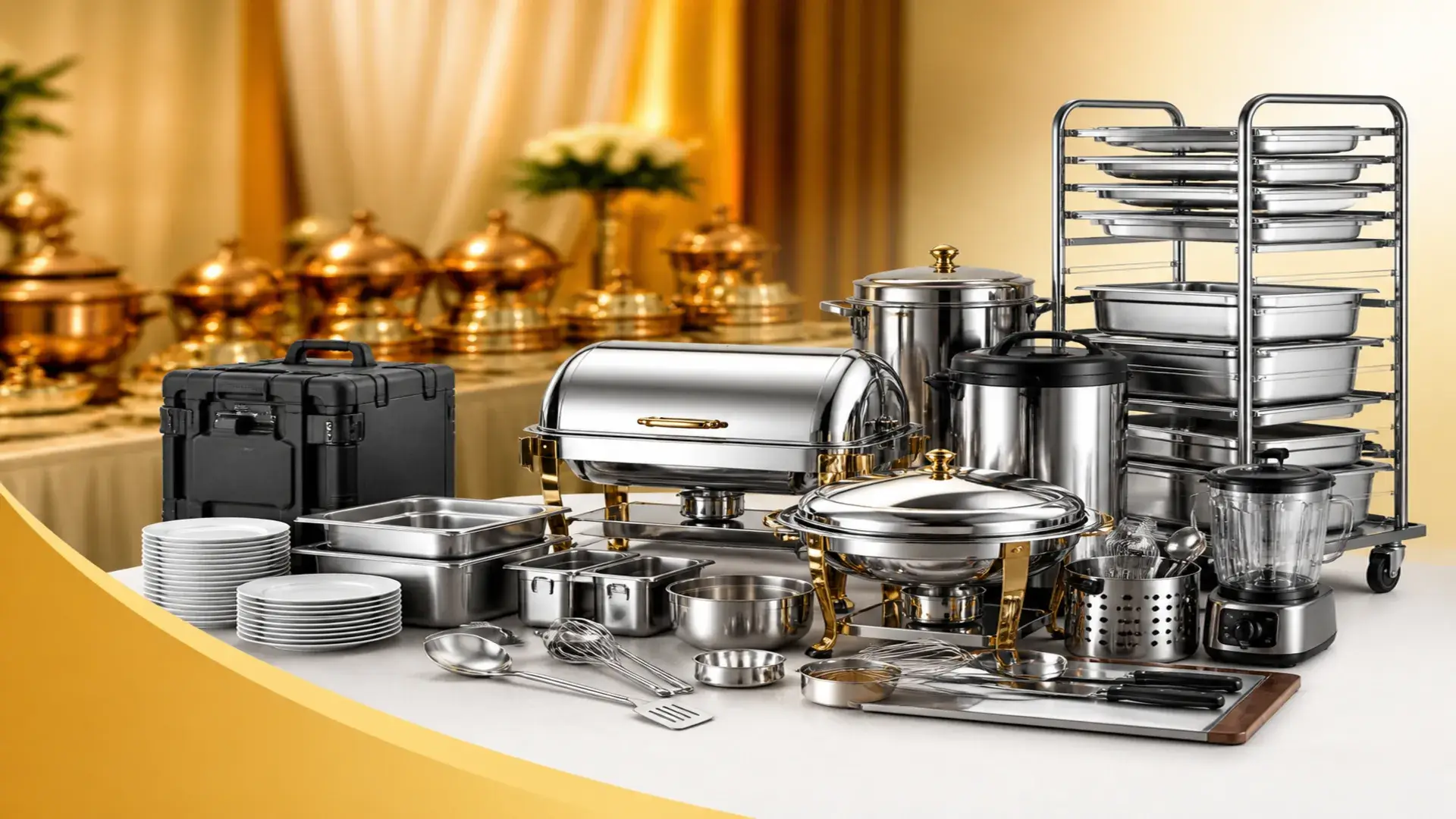
Chafing dishes are the centrepiece of any buffet setup. They use a water pan heated by gel fuel or electricity to maintain serving temperature without direct heat. According to WebstaurantStore’s chafing dish guide, the setup involves filling the water pan with one inch of hot water, lighting the fuel, warming for 20 minutes, then placing hot food in the food pan. For Indian catering, you’ll want a mix of round chafers (for gravies and soups) and rectangular ones (for rice, main courses, and dry dishes). Cater Circle stocks stainless steel chafing dishes through its restaurant and catering supplies section.
Ladles, Tongs, and Serving Spoons
Every chafing dish needs its own serving utensil. Shared ladles between dishes create cross-contamination risk. Standard issue for a 20-dish buffet: 20 serving spoons or ladles plus a set of tongs for dry items. Stainless steel handles are mandatory — plastic handles near open flame fuel are a liability.
Serving Trays and Cane Trays
Your wait staff needs serving trays for table service, clearing, and beverage rounds. Cane serving trays are popular for weddings and traditional events in Kerala for aesthetic reasons; stainless steel trays are better for high-volume clearing and beverage service.
Disposables: Plates, Glasses, Containers
For large outdoor events, disposable plates, glasses, and containers reduce washing logistics and breakage risk. The catering equipment checklist from Top Shelf Concepts recommends bamboo or eco-friendly disposables as a cost-effective option for events where dinnerware transport isn’t practical. Cater Circle stocks paper containers, plastic containers, aluminium containers, and disposable plates and glasses through its catering and restaurant essentials range.
5. Transport and Off-Premise Equipment
For caterers who operate off-premise — which is most of the catering industry in India — transport equipment is a separate, critical investment layer.
Food Pan Carriers and Thermal Containers
Insulated food pan carriers maintain hot food at serving temperature during transit. Cold food containers with dry ice capacity handle cold salads, desserts, and beverages. For Kerala’s events — whether a wedding in Kannur or a corporate event in Kozhikode — the gap between your kitchen and the venue can be 30 to 90 minutes, and food temperature must hold through that window.
Stainless Steel Storage and Prep Containers
Stackable SS containers with lids for marination, pre-cooked ingredient storage, and ingredient transport are the workhorses of off-premise logistics. A full complement of sizes — from 2 litre to 20 litre — gives you flexibility across menu items.
6. Hospitality and Service Supplies
Catering is not just about the food — it’s about the complete service experience. Linens, uniforms, and ancillary supplies are part of the full catering equipment requirements list, particularly for formal events. Cater Circle’s commercial and hospitality supplies section covers uniforms, towels, bed linen, and cleaning supplies for hospitality businesses.
Staff Uniforms
Consistent, branded uniforms signal professionalism and make your staff identifiable to guests. For high-end weddings and corporate events, this is no longer optional — clients expect a cohesive presentation from service staff.
Cleaning and Sanitation Supplies
The FSSAI guidance for the catering sector requires that cleaning facilities and sanitation fitments be integrated into the kitchen layout. That means commercial-grade cleaning liquids, garbage bins, tissue paper, and hygiene stations must be part of your standard equipment inventory — not afterthoughts.
7. FSSAI Compliance and Food Safety Equipment
All food business operators in India are required to obtain FSSAI registration or licensing before operations begin. Caterers with annual turnover above Rs. 20 crores require a Central FSSAI licence; smaller operations fall under State or Basic registration tiers. Beyond the licence, several equipment requirements flow directly from FSSAI’s manufacturing guidelines for the catering sector:
- Food contact surfaces must be non-absorbent and easy to sanitize — stainless steel throughout the prep and cooking zones
- Separate storage areas for raw, cooked, and ready-to-eat foods
- Adequate refrigeration to maintain cold chain integrity
- Color-coded utensils and cutting boards to prevent cross-contamination
- Designated handwashing stations separate from food prep sinks
Getting these requirements right from setup saves you from compliance issues later. The Cater Circle restaurant kitchen equipment list maps out how FSSAI-compliant workstation design translates into specific equipment purchases.
Quick-Reference Catering Equipment Checklist
Use this as a planning checklist before your first event or before scaling up your operation:
Cooking Zone
- Commercial gas range (min. 4–6 burners)
- Commercial kadai set (5L, 15L, 30L minimum)
- Deep fat fryer (temperature-controlled)
- Commercial wet grinder
- Food processor / commercial blender
- Portable induction cooktops for action stations
Prep Zone
- Stainless steel work tables
- Color-coded cutting boards (min. 3 sets)
- Commercial knife set with honing steel
- Kitchen scales and measuring tools
- Mixing bowls, colanders, prep containers (multiple sizes)
Storage and Cold Chain
- Commercial refrigerator (right-sized for peak volume)
- Deep freezer for long-term ingredient storage
- Ice boxes for off-premise transport
- Insulated food pan carriers
Buffet and Serving
- Chafing dishes (round + rectangular, quantity matched to menu dish count)
- Chafer fuel supply
- Ladles and serving spoons (one per dish)
- Stainless steel tongs
- Serving trays (SS and cane variants)
- Disposable plates, glasses, and containers for outdoor events
Hospitality and Compliance
- Staff uniforms
- Commercial-grade cleaning liquids
- Garbage bins and garbage bags
- Tissue paper supply
- Handwashing station equipment
- FSSAI-compliant food contact surface materials throughout
Frequently Asked Questions
What equipment is used in catering?
The core equipment used in catering covers four functional zones: cooking equipment (commercial gas ranges, kadais, fryers, induction cooktops), prep equipment (stainless steel work tables, knives, processors), cold storage and transport equipment (refrigerators, ice boxes, insulated carriers), and serving equipment (chafing dishes, ladles, serving trays, disposables). The specific list varies by menu type and event scale.
What are the FSSAI equipment requirements for catering businesses in India?
FSSAI requires that food contact surfaces be non-absorbent and easy to clean, that food storage be segregated by food type (raw, cooked, ready-to-eat), that cold chain equipment be adequate for the volume of food handled, and that sanitation and handwashing facilities be available in or adjacent to the food preparation area. These requirements apply to all registered food business operators regardless of scale.
How many chafing dishes do I need for a buffet?
A standard rule is one chafing dish per hot dish in your buffet menu. For a 20-dish Indian buffet, plan for at least 15 chafing dishes covering the hot items, with cold food displays for salads and desserts. A buffet setup for 100 guests typically requires a budget of around Rs. 50,000 to Rs. 80,000 for quality chafing dishes, serving utensils, and warming equipment.
What is the difference between restaurant equipment and catering equipment?
Restaurant equipment is typically fixed, high-capacity, and connected to permanent utilities (gas lines, commercial exhaust systems). Catering equipment, by contrast, prioritises portability, durability during transport, and self-contained operation — hence the importance of portable induction units, insulated carriers, and fuel-based chafing dishes. The Cater Circle guide comparing hotel vs home cookware explores these distinctions in practical terms.
Where can I buy catering equipment in Kannur, Kerala?
Cater Circle at Manjapalam, Kannur stocks the full range — commercial cookware, chafing dishes, serving trays, ice boxes, disposables, hospitality linens, and commercial kitchen equipment — under one roof. Visit catercircle.in or contact the team at +91 702 557 6666.