
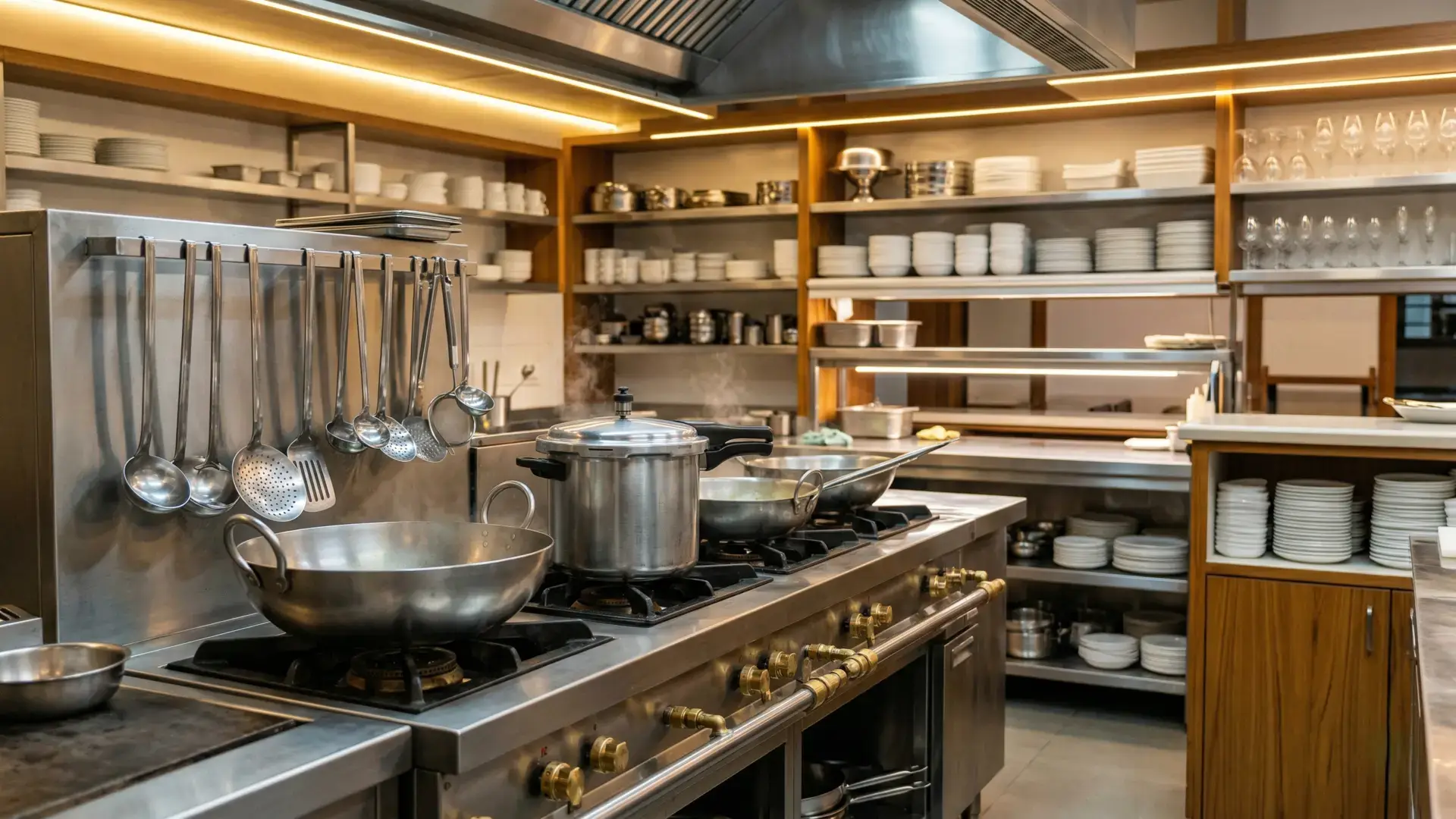
India’s food service industry is booming. According to the IMARC Group, the sector was valued at USD 50.99 billion in 2024 and is projected to reach USD 123.5 billion by 2033, growing at a CAGR of over 10%. That’s a lot of new restaurants, cloud kitchens, and catering businesses hitting the market — and every single one of them needs a properly equipped kitchen before they can serve a single plate.
Here’s the hard truth: most first-time restaurateurs spend weeks perfecting their menu and logo, then scramble at the last minute when they realize they don’t have the right cookware, refrigeration, or prep tools. Getting your restaurant kitchen equipment list right from the start isn’t just a logistics task. It’s the foundation your entire operation runs on.
Whether you’re setting up a full-service restaurant, a QSR, or a catering business in Kerala, this guide covers everything you need — categorized by kitchen zone, grounded in industry standards, and tailored to the Indian context.
Why a Structured Kitchen Equipment List Matters
A well-planned restaurant and catering equipment setup does more than keep your kitchen running. It directly affects your food quality, service speed, and FSSAI compliance.
The Food Safety and Standards Authority of India requires that all food business operators maintain equipment made of non-absorbent, easy-to-clean materials that prevent microbial growth. Stainless steel surfaces, proper refrigeration, and sanitation-ready workstations aren’t optional — they’re law.
Beyond compliance, a thoughtful equipment list helps you:
- Speed up service by eliminating workflow bottlenecks
- Control portion costs through accurate prep tools and scales
- Reduce waste with proper cold storage and holding equipment
- Protect your staff with ergonomically placed, purpose-built tools
Now, let’s get into the actual list — broken down by kitchen zone, the way real commercial kitchens operate.
Zone 1: The Preparation Area
This is where everything starts. Ingredients come in raw, and they leave the prep zone ready to cook. Getting the prep area right is critical for speed and hygiene.
Essential Prep Equipment
Commercial Stainless Steel Work Tables are the backbone of any prep kitchen. They’re durable, corrosion-resistant, and easy to sanitize — exactly what FSSAI mandates. Size your tables to your volume: a 10-cover restaurant has very different needs from a 100-cover operation.
Cutting Boards (Color-Coded) — this one matters more than most people realize. Separate boards for raw meat, vegetables, and cooked food prevents cross-contamination, a requirement in the FSSAI’s suggested food safety checklist. Never skip this. Your inspectors won’t.
Commercial Food Processors and Wet Grinders are non-negotiables for Indian kitchens. South Indian menus in particular rely on freshly ground batters for dosa and idli — commercial wet grinders handle large volumes that domestic machines simply can’t. North Indian kitchens need high-capacity mixers for dough and masalas.
Chef Knives and Professional Cutting Tools — invest here. Dull knives slow down prep and increase injury risk. A proper knife set includes a chef’s knife, paring knife, bread knife, and a cleaver for meat-heavy kitchens.
Mixing Bowls, Colanders, and Prep Containers in multiple sizes. These seem obvious until you realize you only bought two bowls and now your entire marination workflow is stuck waiting.
Kitchen Scales and Measuring Tools for portion control. Consistency in recipes translates to consistent food cost — and consistent guest experience.
Zone 2: The Main Cooking Area
This is the heart of your restaurant kitchen. The main cooking area is where your restaurant’s identity is built — and where most of your budget should go.
Core Cooking Equipment
Commercial Gas Ranges and Burner Stoves — for Indian kitchens, you need high-output burners capable of handling heavy-duty stir-frying, curry cooking, and simultaneous multi-dish preparation. Most full-service restaurants need at minimum a 4-6 burner commercial gas range. Biryani operations and high-volume curry kitchens often go up to 8 burners.
Tandoor Oven — if you’re running a North Indian or Mughlai menu, the tandoor isn’t optional. It’s the primary equipment for naan, roti, tandoori chicken, and kebabs. Available in gas-fired and charcoal-fired variants, as detailed in this Indian restaurant kitchen guide.
Commercial Tawa (Griddle) — critical for South Indian restaurants and any menu featuring dosa, chapati, and paratha. Flat-top tawas allow even heat distribution across the cooking surface and can handle high-order volumes.
Kadai (Commercial Wok) — the workhorse of Indian curry cooking. A deep, heavy-gauge kadai is perfect for tempering spices, frying, and preparing gravies. Commercial kadais come in capacities ranging from 5 liters to 30+ liters for batch cooking.
Deep Fat Fryer — essential for snack-heavy menus, fast food operations, and South Indian banana chips or vada prep. Look for temperature-controlled commercial fryers with oil filtration systems to extend oil life and maintain food quality.
Pressure Cookers (Commercial Grade) — Indian cuisine relies heavily on pressure cooking for dals, pulses, and slow-cooked meats. Commercial pressure cookers come in 5-liter to 30-liter capacities and can dramatically reduce cooking times. You’ll find a solid range of commercial cookware options suited to high-volume restaurant use.
Induction Cooktops — increasingly popular in modern commercial kitchens for their energy efficiency and precise temperature control. They’re especially useful in catering setups where LPG logistics are challenging.
Exhaust Hood and Ventilation System — mandatory in Indian commercial kitchens. Heavy spice usage and high-heat cooking generate significant smoke and grease vapor. A properly sized exhaust hood keeps your kitchen safe and FSSAI-compliant.
Zone 3: Food Holding and Service Equipment
This zone bridges the kitchen and the dining room. Food comes out of the cooking zone and needs to be held at safe temperatures before it reaches the guest.
Holding and Service Tools
Chafing Dishes are the most visible piece of your service setup — especially for buffets, weddings, and catering events. They keep food hot during service through water baths or dry heat. If you’re running catering operations, chafing dishes and serving trays are absolute must-haves.
Bain-Marie Counters keep pre-cooked curries, dals, and gravies at serving temperature during peak hours. Essential for high-volume restaurants where batch cooking is the norm.
Ice Boxes and Cold Display Units for chilled beverages, desserts, and cold appetizers. Per FSSAI operational standards, cold food must be maintained at or below 5°C, and frozen food at -18°C or lower.
Ladles, Serving Spoons, and Tongs — you’ll need more than you think. A rule of thumb: have dedicated serving tools for every dish in your bain-marie, plus backup sets. Cross-contamination between veg and non-veg dishes is a common FSSAI compliance issue.
Serving Trays (General and Cane) — for restaurant table service and catering setups. Cane trays add a traditional touch popular at Kerala-style banquet services, while stainless steel trays are the workhorse for high-volume cafeteria service.
Disposables for Catering — plates, glasses, paper containers, and aluminium foil containers. For large catering events, disposables are practical and cost-effective. Look for food-grade options that comply with packaging standards under FSSAI regulations.
Zone 4: Refrigeration and Cold Storage
One of the most expensive line items on your list — and one of the most important. Improper refrigeration is the leading cause of food spoilage and the fastest way to fail an FSSAI inspection.
Refrigeration Must-Haves
Commercial Refrigerators (Vertical and Countertop) — size based on your daily ingredient volume. Vertical reach-in refrigerators are space-efficient; chest freezers offer higher volume storage for proteins.
Walk-In Cold Rooms — for restaurants doing significant volumes (50+ covers daily), a walk-in cooler is worth the investment. It allows organized storage, proper labeling, and temperature-zoned sections for different ingredients.
Under-Counter Refrigeration — placing refrigerated units directly in the prep line reduces the number of steps chefs take to access cold ingredients, improving workflow efficiency.
A quick note on compliance: the FSSAI’s catering guidance document is explicit — hot food must not sit below 65°C for more than two hours, and cold food must stay below 5°C at all times. Your refrigeration setup is your first line of defense.
Zone 5: The Cleaning and Sanitation Area
This is the most overlooked zone in restaurant planning. Don’t be that operator who realizes post-launch that there’s no hot water at the dish station.
Cleaning Equipment You Need
Commercial Dishwashers — for restaurants doing any meaningful volume, hand-washing alone won’t cut it. Commercial dishwashers sanitize at high temperatures (typically above 82°C, as required by FSSAI’s meat handling guidance), handling large volumes of plates, glasses, and cookware in minutes.
Three-Compartment Sinks — a restaurant standard. One compartment for washing, one for rinsing, one for sanitizing. Separate sinks for food preparation and equipment cleaning prevent cross-contamination.
Garbage Bins with Foot Pedals — FSSAI mandates covered garbage bins with foot-operated pedals for waste disposal. This keeps hands free and reduces contamination during service.
Cleaning Agents and Liquid Soaps — the commercial hospitality section covers industrial-grade cleaning materials, liquid soaps, and fresheners suited to high-use commercial environments.
A Quick-Reference Restaurant Kitchen Equipment List
| Category | Equipment | Priority |
| Prep | Stainless steel work tables | High |
| Prep | Commercial food processor / wet grinder | High |
| Prep | Color-coded cutting boards | High |
| Prep | Chef knife set | High |
| Cooking | Commercial gas range (4-8 burners) | High |
| Cooking | Tandoor oven | Medium (menu-dependent) |
| Cooking | Commercial tawa | High |
| Cooking | Kadai (commercial grade) | High |
| Cooking | Deep fat fryer | Medium |
| Cooking | Commercial pressure cookers | High |
| Cooking | Exhaust hood + ventilation | High (mandatory) |
| Service | Chafing dishes | High |
| Service | Bain-marie counter | High |
| Service | Ladles, serving spoons, tongs | High |
| Service | Serving trays | High |
| Cold Storage | Commercial vertical refrigerator | High |
| Cold Storage | Chest freezer | High |
| Cleaning | Commercial dishwasher | Medium-High |
| Cleaning | Three-compartment sink | High |
| Cleaning | Foot-pedal garbage bins | High |
Budgeting Your Restaurant Kitchen Equipment
Setting up a restaurant kitchen in India requires allocating your budget across categories smartly. According to Kouzina Food Tech’s analysis of restaurant kitchen setup costs, roughly 60% of your total kitchen budget should go toward essential equipment — stoves, ovens, refrigeration, and prep stations. That typically works out to approximately ₹3.6 lakh to ₹12 lakh depending on your restaurant type and city.
The remaining budget splits across carpentry and civil work (about 20%) and furniture and fixtures (about 15%). These proportions shift depending on whether you’re in a metro or a smaller city like Kannur, where real estate and contractor costs tend to be more reasonable.
A few practical tips:
Don’t underspec your burners. Indian cooking is heat-intensive. Home-grade or even entry-level commercial burners burn out fast under restaurant-volume use. Invest in commercial-grade, heavy-duty stoves from the start.
Buy stainless steel wherever possible. FSSAI’s licensing regulations explicitly call for stainless steel, aluminum, or glass containers and surfaces. Chipped enamel and porous materials are non-compliant.
Think in zones. When you’re sourcing equipment, think about workflow — ingredients move from receiving to storage to prep to cooking to holding to service. Equipment that disrupts this flow adds time and increases error.
New Technology Trends Shaping Commercial Kitchens
The complete restaurant kitchen equipment list for 2026 highlights how smart appliances are increasingly entering commercial kitchens — IoT-enabled temperature monitoring, AI-assisted cooking equipment that auto-adjusts settings, and energy-efficient, eco-certified appliances are becoming mainstream even for mid-size operators.
For Indian restaurateurs, the most immediately practical upgrade is induction-based cooking for certain menu items, combined with real-time temperature tracking for cold storage compliance. Both reduce waste and help you stay on the right side of FSSAI inspections.
Frequently Asked Questions
1. What is the most essential equipment for a restaurant kitchen in India?
The non-negotiables are a commercial gas range, refrigeration units, a commercial tawa or griddle, stainless steel prep tables, and a proper ventilation system. Everything else is menu-dependent.
2. How much does restaurant kitchen equipment cost in India?
Basic kitchen equipment for a small restaurant typically starts at around ₹3.6 lakh and can go up to ₹12 lakh or more for larger setups, according to industry estimates. Fine-dining and high-volume operations spend significantly more.
3. What are the FSSAI requirements for restaurant kitchen equipment?
FSSAI mandates that all equipment must be made of non-absorbent, easy-to-clean materials to prevent microbial growth. Cooking utensils and crockery must be clean and in good condition. Stainless steel is the preferred material for most surfaces.
4. Do I need a tandoor oven for my restaurant?
Only if your menu includes tandoori items like naan, tandoori chicken, or kebabs. For South Indian or pan-Indian casual dining, you can skip the tandoor and focus on high-output commercial burners and tawas instead.
5. Where can I source restaurant kitchen equipment in Kannur, Kerala?
Cater Circle, located in Manjapalam, Kannur, is a one-stop destination for restaurant and catering essentials as well as commercial and hospitality supplies. From chafing dishes and ladles to commercial cookware and serving accessories, everything is available under one roof — backed by decades of experience through our parent brand, Popular Stores.
6. What serving equipment do I need for a catering business?
At minimum: chafing dishes, ladles, serving trays, ice boxes, and disposable plates and containers. For higher-end catering, add bain-marie counters, cane serving trays, and insulated food carriers.
Getting your restaurant kitchen equipment list right before opening saves you from expensive mid-operation fixes. Think in zones, prioritize FSSAI compliance, invest in commercial-grade quality, and source from a supplier who understands the real demands of a working kitchen.
If you’re setting up or upgrading a kitchen in North Kerala, visit Cater Circle in Kannur or call us at +91 702 557 6666. We’ve been helping restaurants, hotels, and caterers get fully equipped since 1943.
Cater Circle — The Complete Kitchen Zone. Parakkandy, Manjapalam, Kannur, Kerala 670001.